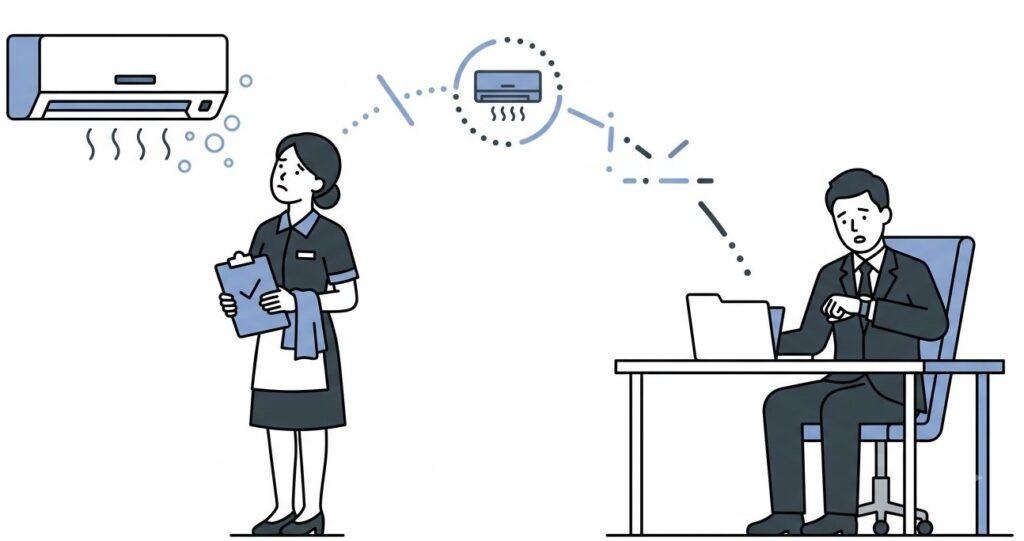
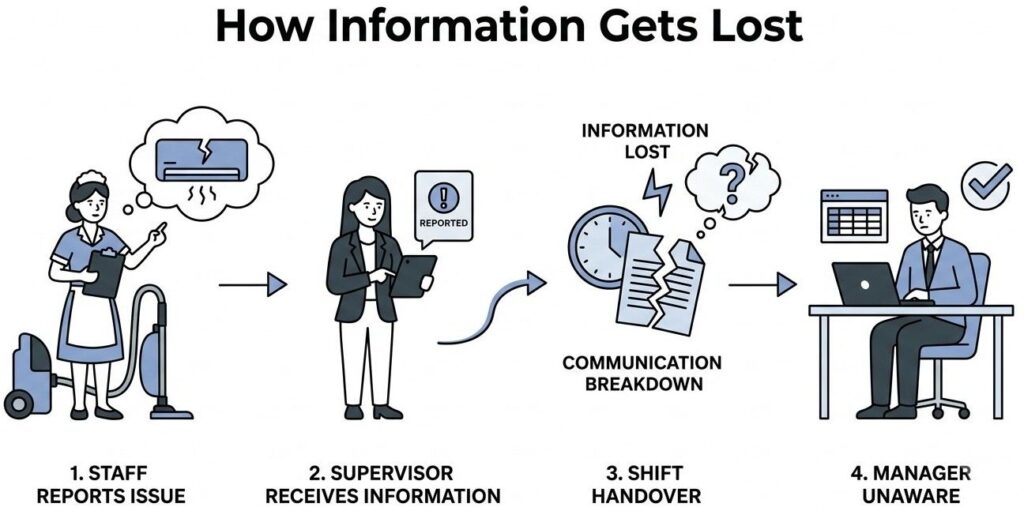
At 10:15 on a Tuesday morning, a room attendant walks into room 412. The guest checked out an hour ago. The thermostat sits at its lowest setting, and a handwritten note on the desk says the room never cooled all night.
She has seen this before. Yesterday, in fact, a guest two doors down said the same thing in the corridor. She tells her floor supervisor between two trolleys, and the supervisor nods. The supervisor plans to pass it to the front desk once the rush is over.
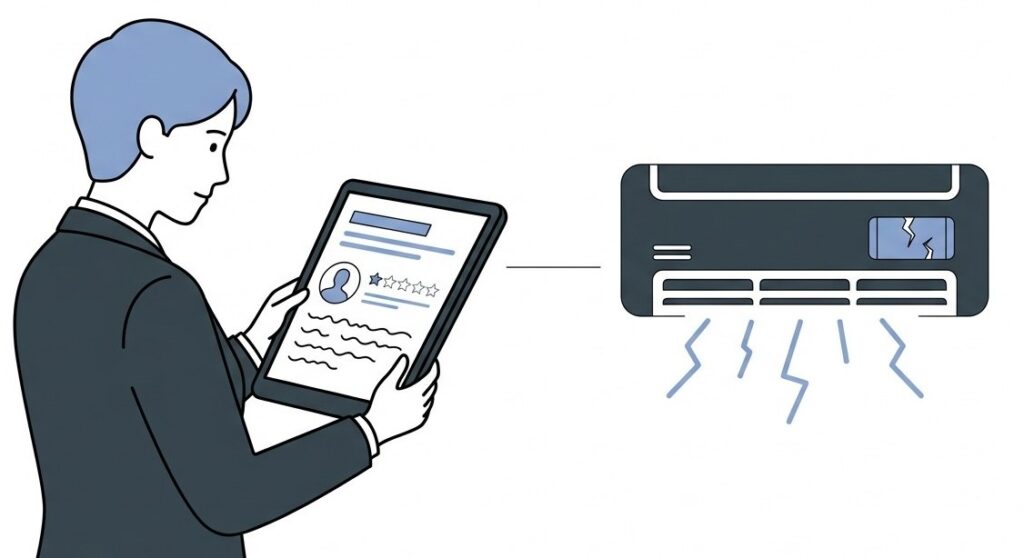
Then 2 pm arrives and the shift changes. The supervisor goes home with the message still in her head, and the evening team never hears it. A new guest checks into 412 that night, and the air conditioner fails again. Finally, on Friday, the general manager reads a one-star review that names the room number.
The attendant knew on Tuesday morning, but the general manager knew only on Friday, from a stranger online. This story is a composite, but any housekeeping supervisor will recognise it.
Housekeepers see what guests never say out loud
Room attendants spend more time inside guest rooms than almost anyone else on the payroll, and they usually see the room when the guest is not performing for anyone. Which side of the bed got used is obvious to them. So is the untouched welcome fruit, the suitcase that never got unpacked, and the third request for extra towels scribbled on a notepad. Yet how guests actually live in a room often differs from what they say at the desk, and the attendant is the one who sees the difference.
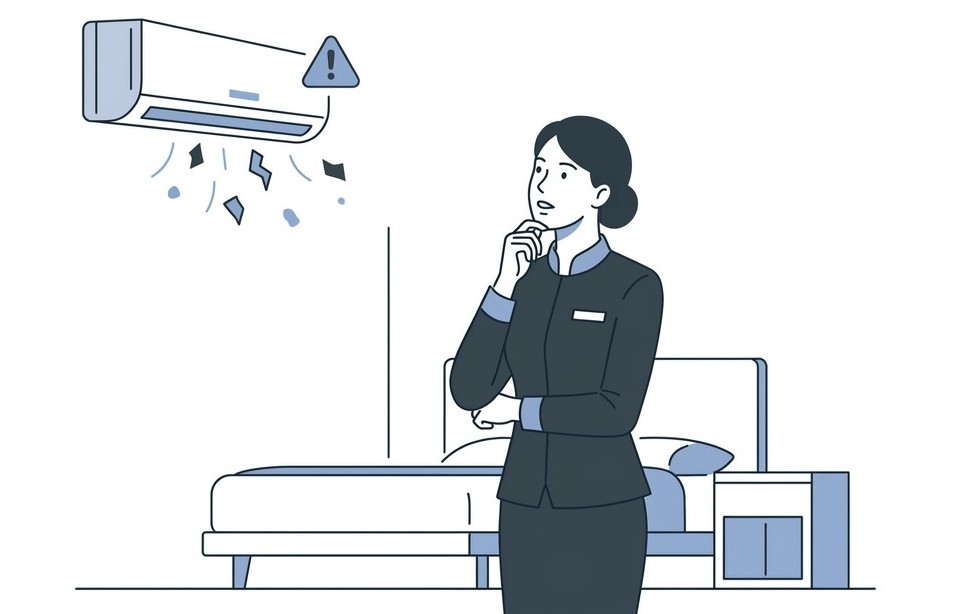
Guests also talk to them. Sometimes one mentions the noisy neighbour in passing, while another asks whether the bathroom fan always sounds like that. Yet nobody writes these remarks down, and the guest never thinks of them as complaints.
Most unhappy guests tell a frontline employee, or nobody
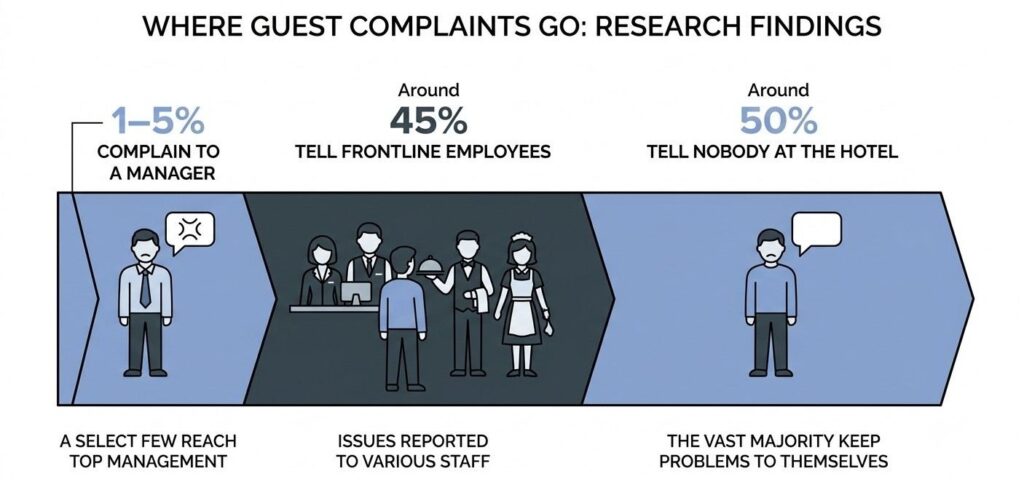
Research on complaint behaviour shows why this matters. A review of hospitality complaint studies reports that only 1 to 5 percent of unhappy customers complain to a manager. Meanwhile, about 45 percent tell a frontline employee, and around 50 percent tell no one at the hotel. Likewise, a 2019 industry survey of more than 1,100 US consumers found that only 25 percent of guests report an issue that affects their stay. Nearly half said they skip reporting because there is no easy way to do it or because they dislike confrontation.
Read those numbers from the GM’s chair. The manager hears from a sliver of unhappy guests, while the people on the floor hear far more, and they hear it first.
A room tells a story to anyone who looks long enough. For example, a thermostat pushed to its lowest setting says the cooling is weak. Two unopened bottles of water by the bed say the guest never found the minibar price list, or never trusted it. Each detail is small, but together they describe how the hotel really performs, one room at a time, and the people who read those details every day sit at the bottom of the org chart.
Why the GM always hears last
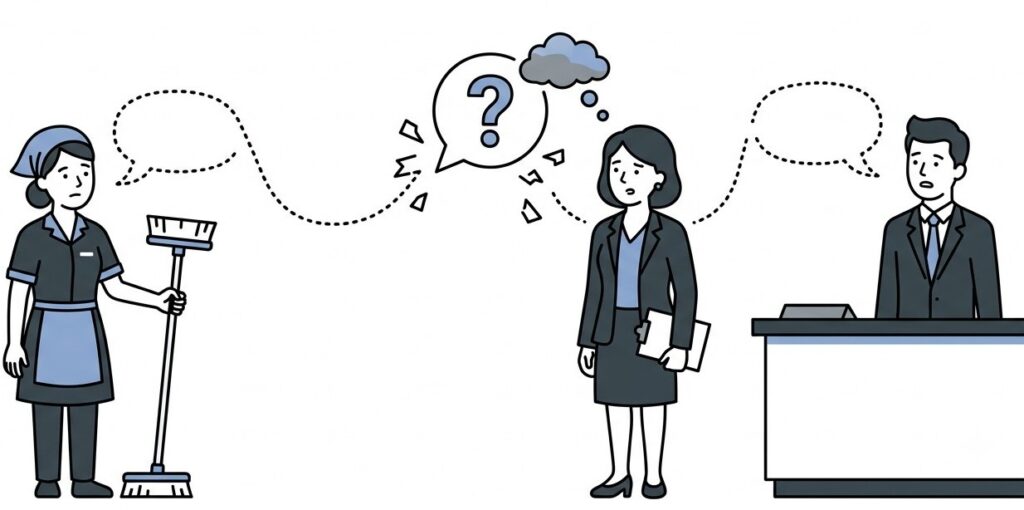
Every handoff is a small editing job. Whoever carries a message decides whether it deserves to travel further. For instance, an attendant may think a warm air conditioner belongs to maintenance, not the front desk. A supervisor may treat two similar remarks as a coincidence. A front desk agent may mean to log it, and then a tour bus arrives.
None of this comes from laziness, since most staff act in good faith. The system gives them one channel, which is talking, and talking works well for urgent problems and badly for everything else. Word of mouth also feels efficient, because sharing costs nothing in the moment. The cost arrives later, in a review or a lost repeat guest, and nobody traces it back to a sentence that never got repeated.
As a result, by the time information climbs from the corridor to the GM’s office, it has usually shrunk to nothing or turned into a rumour.
What hospitals and aviation crews teach us about lost handoffs
Hotels have published few studies on shift handoffs, so this section borrows from fields that have measured the problem closely. Hospitals are not hotels, and the stakes differ. Still, the mechanism looks the same: a tired person tells the next person what they remember, in a hurry, in a noisy place.
Start with a study published in JAMA Internal Medicine in 2014. Researchers at two Toronto hospitals observed 26 morning handovers and tracked 141 clinically important overnight issues. The overnight trainee left out 40.4 percent of those issues during the verbal handover. For 85.8 percent of them, the trainee wrote nothing in the patient record. A written sign-out tool was available, yet it captured only 7.8 percent of the issues. The teams also faced 6.2 distractions an hour during these handovers, and more distractions meant fewer overnight issues got discussed.
A hotel corridor at shift change has its own version of that noise.
Other hospital studies find the same leak, and it widens at night
A 2015 study in the Singapore Medical Journal watched verbal handovers for 152 patients. Phone calls let people ask questions, but the lack of written information caused steady information loss. In addition, the setting was chaotic, and the doctors had no set time or place to hand over.
A study of 89 internal medicine residents at the University of Virginia shows the same pattern at a larger scale. Only 24 percent of the residents said their sign-out forms had no major errors or omissions. Information also thinned out at night. Lab results came up 24 percent less often on the night shift than on the day shift, and treatment plans came up 21 percent less often. Nights matter in a hotel too, because the 11 pm towel request and the 2 am noise complaint belong to people who may be asleep by breakfast.
Aviation maintenance crews hit the same wall
NASA studied the same problem in aviation maintenance. Its experimental paper notes that in dynamic industries, errors and accidents happen more often right after a shift handover. In the experiment, adding audio recordings to written logs cut task errors significantly compared with written logs alone. A thin note, in other words, does not carry everything a person knows.
The few hotel studies point the same way
The studies are small, but they agree with the hospital work. A 2019 qualitative study of hotel front office managers found that every manager agreed communication problems hurt productivity, and that the damage reached beyond the front office to all hotel activities. A 2024 study at a hotel in Pekanbaru, Indonesia, interviewed four staff members, including a front office supervisor, a housekeeping supervisor, a front desk agent and a room attendant. It found that miscommunication between front office and housekeeping still happens, and that the form of communication between the two departments was what held coordination back. Still, treat both as signals, not proof.
What a hotel loses when the message never arrives
Start with the guest. The guest who gets the broken air conditioner on Tuesday night will most likely tell nobody at the hotel, if the complaint research above holds. That guest checks out and writes a review instead.
That is where money enters. Chris Anderson of Cornell’s School of Hotel Administration studied how online reviews affect hotel performance. In a 2012 report from the Cornell Center for Hospitality Research, he found that a hotel that raises its review score by 1 point on a 5 point scale, say from 3.3 to 4.3, can raise its price by 11.2 percent and keep the same occupancy. Separately, he matched review scores to hotel sales data and found that a 1 percent rise in a hotel’s online reputation score led to up to 1.42 percent more revenue per available room. The effect was larger for midscale hotels than for luxury ones.
Anderson used US data from the early 2010s, so treat the exact figures as a guide, not a forecast for any property in India. The direction, though, is what matters. Reviews move price and demand, and a recurring fault that nobody fixed is a reliable way to earn a bad one.
Information also leaks out slowly, over months. The supervisor who knows that 412 runs warm and that a regular guest hates feather pillows carries a map of the hotel in her head. When she changes jobs, the map leaves with her. A hotel that never wrote it down has to learn it again, one bad stay at a time.
Why managers rarely ask for it
Most management reports count what staff logged. That sounds fair until you ask what never got logged. A complaint dashboard shows the issues that someone typed in. It cannot show the three that a supervisor mentioned on the stairs and forgot by lunch. So the numbers look calm, and calm numbers make a GM feel informed.
This is a quiet kind of blind spot. Nobody hides anything and no report contains a lie. Instead, the data covers only the part of the hotel that has a form attached to it. The closer a person stands to the guest, the less likely it is that what they know reaches the top.
The Pekanbaru study hints at the same thing from the inside. That study found coordination going fairly well overall, with room to improve. People can feel fine about a handoff that is quietly losing information, because they only see their own half of it.
Capturing what staff notice takes less than most managers expect
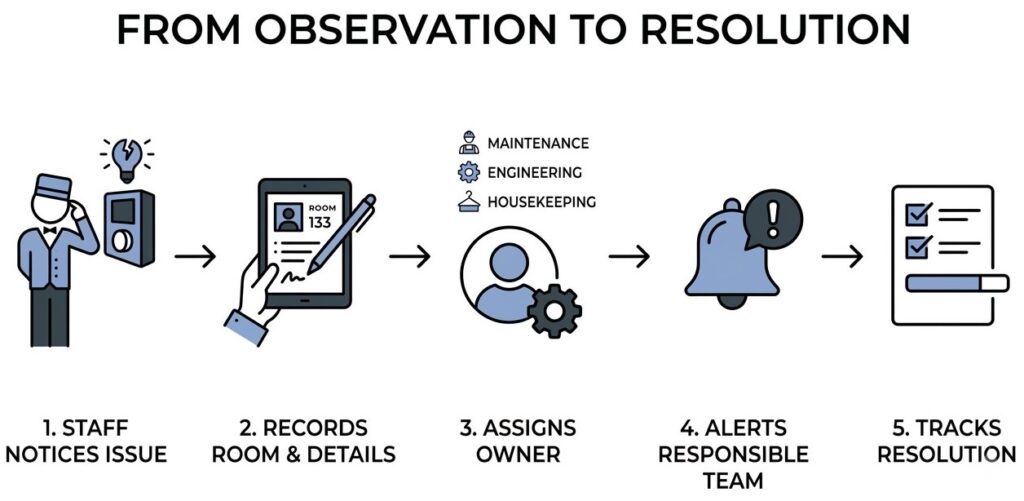
A good capture habit does not need fancy tools. It needs a few plain rules instead.
Make it fast. If logging a problem means walking to a desk, it will not happen. The note should take under a minute, at the moment the attendant sees the problem, on a device she already carries.
Name the room and the problem, and add a photo when the problem is visible. The NASA result points the same way: more context beats a thin note.
Give every note an owner. A note that nobody owns is just a rumour with better handwriting.
At shift change, work through a list instead of asking “anything to report?” In the Toronto study, teams that went through the patient list one by one handed over overnight issues more reliably. In a hotel, that list is the open issues, room by room.
End each shift with one question: what did guests mention today that we did not log? Supervisors usually have an answer ready, and it is, in fact, often the most useful line in the whole handover.
Tell the person who reported what happened next. An attendant who hears that her report fixed room 412 usually reports the next problem too. Silence teaches her to stop.
Tools alone, however, will not do it. The same Toronto hospitals later tested a handoff improvement bundle, and it did not improve how often overnight issues got handed off. A form cannot replace a habit. The habit comes first, and software can help it stick.
One week is enough to see the gap
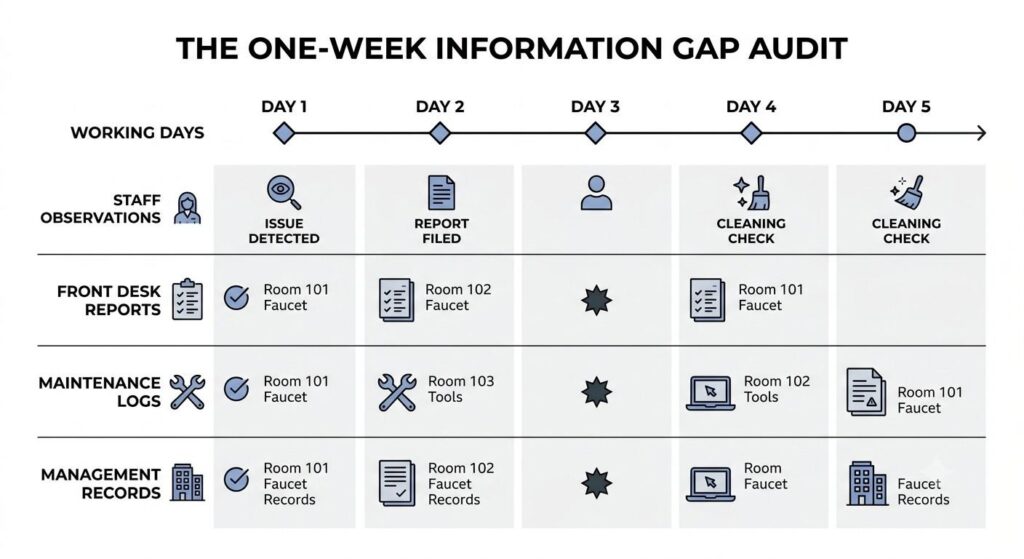
Try a simple test. Ask your housekeeping supervisor to write down everything her team says out loud for five working days, in her own words. That includes what guests said, what rooms looked like and what broke. Then compare her list with what reached the front desk, the maintenance log and your own desk.
The gap between those lists is the intelligence your hotel loses today, and you can measure it before spending anything.
Look at what sits in the gap. Chase the items that repeat across rooms first. A fault that shows up in three rooms, for instance, is a building problem, and no single guest complaint would have told you that.
Once the habit exists, complaint management software built for hotels can take care of the capture part. The good ones work on feature phones as well as smartphones, and they can alert managers by SMS, WhatsApp or a mobile app. If you would like to see how that could work at your property, book a demo.