
Here is something most hotels do not talk about openly: for every guest who complains at the front desk, three more quietly pack their bags, check out, and never come back.
They do not make a scene. They do not ask to speak to a manager. They just leave, and somewhere between the lobby and the parking lot, they decide they are done with your hotel.
Research backs this up: only 25% of guests who have a problem actually report it to hotel staff. The other 75% stay silent, which sounds manageable until you realize silent guests are often the angriest ones. They just save it for TripAdvisor.
So the real question is not “how does a hotel handle complaints?” The real question is: what happens to the complaints a hotel never even hears?
A Message That Never Arrived
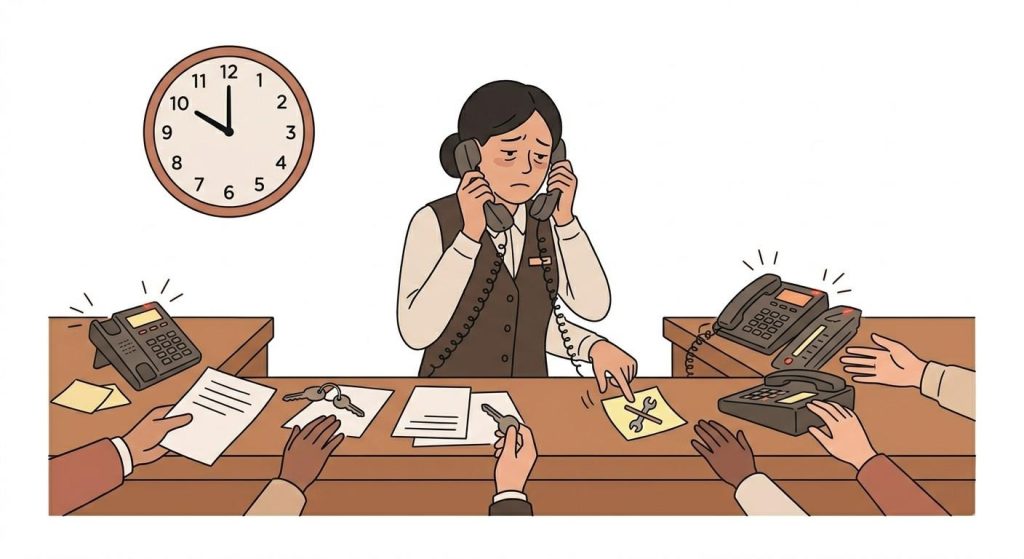
Picture this. It is a Friday night. The hotel is 90% full. A guest in room 412 calls the front desk at 11 PM. The AC is broken, and the room feels like a greenhouse. The front desk agent, managing two other calls and a queue of late check-ins, logs the complaint on a sticky note, promises someone will come by, and gets back to the chaos.
The note never makes it to maintenance.
By morning, that guest has slept in a 28-degree room. By checkout, they have already drafted their review in their head. By the time the hotel reads it online, there is nothing left to fix.
This is not a story about a bad employee. It is a story about what happens when a busy hotel relies on memory, sticky notes, and good intentions to manage guest problems. Complaints are slippery. They arrive at the worst times, travel through too many hands, and disappear quietly while everyone assumes someone else followed up.
That gap, between a complaint being received and a complaint being resolved, is exactly where guest satisfaction goes to die.
What Automation Actually Does (It Is Less Complicated Than It Sounds)
The word “automation” makes some hotel managers picture robots and expensive software overhauls. The reality is much simpler.
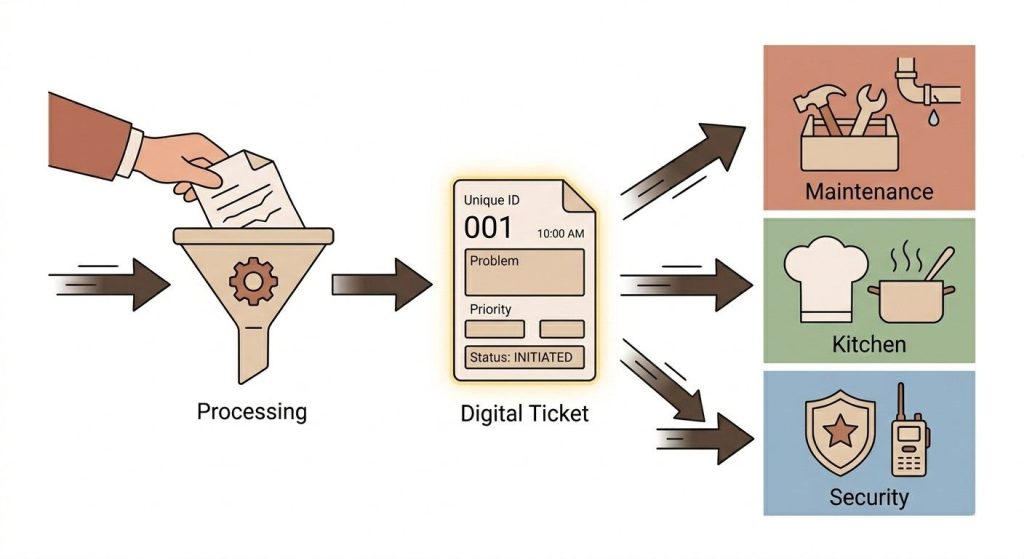
When a guest sends a complaint through an app, a chat system, or even a hotel phone line linked to the right platform, the system captures it instantly and does three things without anyone lifting a finger.
It creates a ticket. It routes that ticket to the right department. And it starts a clock.
A maintenance complaint goes directly to maintenance. A food complaint goes to the kitchen. A noise complaint goes to security. No one has to read it, decide who handles it, and then make a phone call to pass it along. That whole chain, which used to take minutes or sometimes hours, now takes seconds.
And here is the part that changes everything: the system does not forget. A ticket opened at 9 PM and still unresolved at 9:30 PM automatically escalates to a supervisor. By 10 PM, a manager is getting an alert. No one has to babysit the process. The process babysits itself.
The 24-Hour Window Hotels Cannot Afford to Miss
There is a specific number that should live on the wall of every hotel operations meeting room.
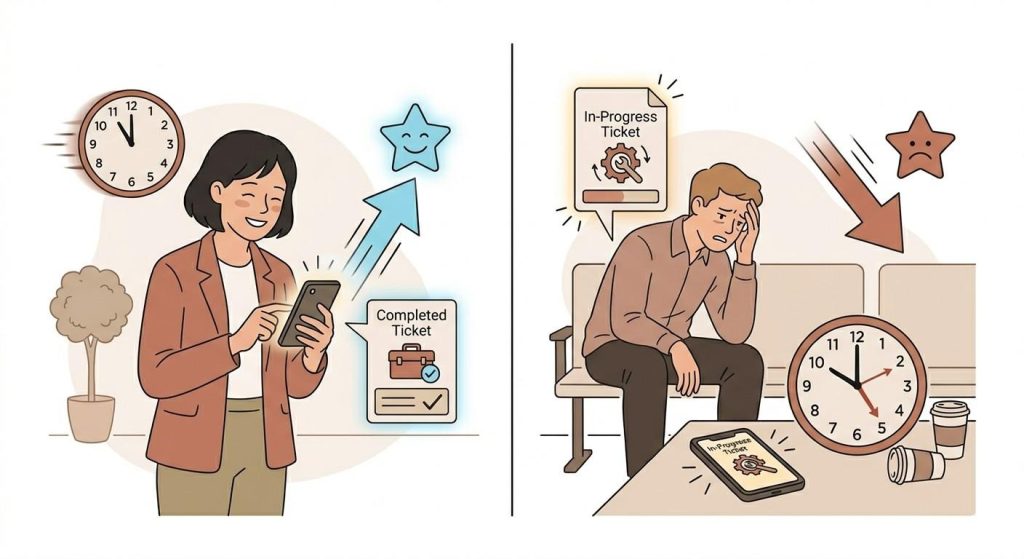
Hotels that resolve guest issues within 24 hours achieve an 80% service recovery success rate. Hotels that take longer? That number drops to 45%. That is not a small gap. That is the difference between a guest who books again and a guest who tells their colleagues to stay somewhere else.
Speed is not just good service. Speed is the entire game in complaint management.
Automated tracking makes speed possible at scale. A property with 200 rooms and a weekend full of guests cannot rely on one manager mentally tracking every open issue. A well-set-up complaints system does that tracking automatically, flags what is overdue, and makes sure nothing slips past the 24-hour window by accident.
When Three Departments Need to Talk to Each Other
Here is a scenario that exposes exactly how fragile manual coordination is.
A guest checks into room 307 and within an hour reports three separate problems. The AC is making a loud noise. The TV remote is dead. And the bathroom drain is slow.
Three problems. Three departments. One very annoyed guest.
In a hotel without shared tracking, the front desk agent calls maintenance, then calls the in-room technology team, then calls housekeeping. Each department hears a different version of the story depending on how rushed the agent was during each call. No one has a full picture. There is no easy way to check whether all three tasks are done before the agent calls the guest back.
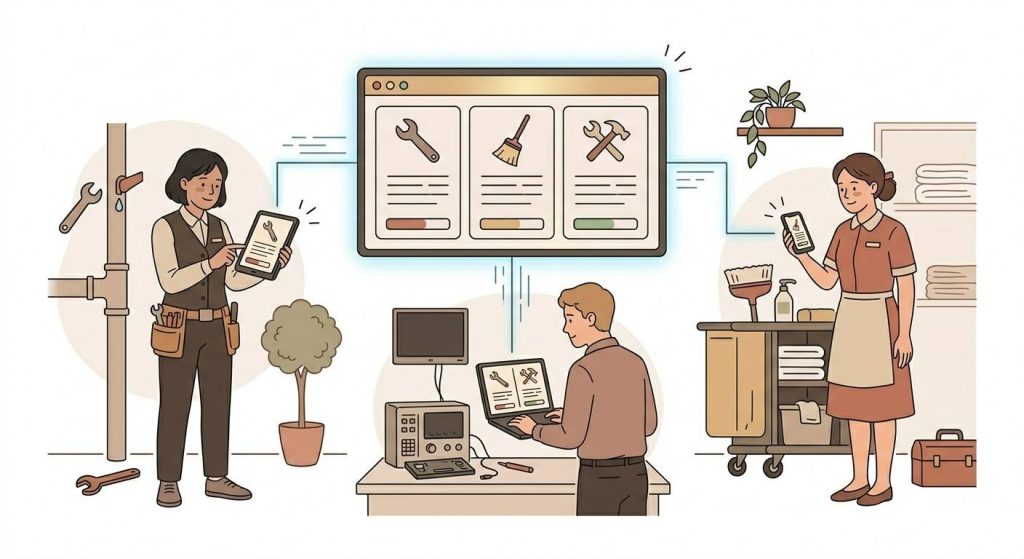
Now run the same scenario through an automated system. One complaint creates three tasks, each assigned to the right department, each visible in a single dashboard. Maintenance sees their job. The technology team sees theirs. Housekeeping sees theirs.
As each task gets completed, the status updates in real time. The front desk agent can glance at the screen and know, without making a single call, that two tasks are done and one is still in progress.
The guest gets a coherent, confident update instead of a series of “I’m still checking on that.”
The Mid-Stay Message Hotels Rarely Send (But Should)

Most hotels wait for complaints to arrive. The smarter ones go looking for them.
An automated mid-stay message, sent around the midpoint of a guest’s visit, does something surprisingly powerful: it gives unhappy guests a private channel to say what is bothering them before they take it public.
Think about what that means. A guest who has been annoyed about slow room service for two days has been building toward a negative review. A mid-stay survey gives them somewhere to put that frustration. The hotel gets the complaint, flags it, and sends someone to follow up while the guest is still on property. The problem gets fixed. The guest checks out feeling heard rather than ignored.
This is not just good hospitality theory. It is practical damage control. 87% of guests say they feel more emotionally connected to a brand when their problem gets actually solved. That emotional connection is what turns a one-time guest into a return booking.
Why 48% of Your Future Guests Are Watching Right Now

Here is a stat that reframes the stakes entirely.
48% of travelers say online reviews are the single biggest factor in choosing a hotel. Nearly half of your future guests are making decisions based on what your current guests write about you.
Every complaint that does not get resolved is a potential review. Every review shapes dozens of future booking decisions. The math compounds fast.
Automated complaint systems break that chain before it starts. A guest whose problem gets fixed quickly and who receives a thoughtful follow-up is far less likely to reach for their phone and start typing. And even when they do write a review, a resolved complaint reads very differently from an ignored one.
The Honest Part: Automation Does Not Run Itself
This is the section most vendors leave out of their sales pitches.
A complaint management system is only as good as the team that uses it. And it is surprisingly easy to get this wrong.
Here is a real example of how implementation fails. A hotel deploys a solid complaint tracking platform and sends a short email to department heads about how it works. Two weeks later, the front desk is using it religiously. The maintenance team has logged into it twice. Housekeeping is still using WhatsApp group chats to coordinate.
The result? Tickets show as open long after the work is done. Managers see false escalations. Staff lose trust in the system because the data looks wrong. The hotel paid for automation and got confused.
The fix is straightforward but requires real commitment. Every department needs hands-on training. Every team lead needs to understand why updating a ticket status matters. And someone in leadership needs to check the system daily in the first month, not because the software requires it, but because habits take time to form.
When the whole team uses the system consistently, the data gets reliable. When the data gets reliable, patterns start appearing. Rooms that generate repeat complaints. Time slots when issues spike. Departments with slower resolution times. The system stops just managing complaints and starts helping the hotel prevent them.
What a Resolved Complaint Actually Buys You
The Numbers That Change How You See Complaints
The numbers at the end of this story are worth sitting with.
A 5% increase in guest retention can improve hotel profitability by 25% to 95%. And 94% of guests say they would return to, or at least seriously consider returning to, a hotel that turned their bad experience into a good one by resolving the problem immediately.
The Service Recovery Paradox: Why Problems Can Build Loyalty
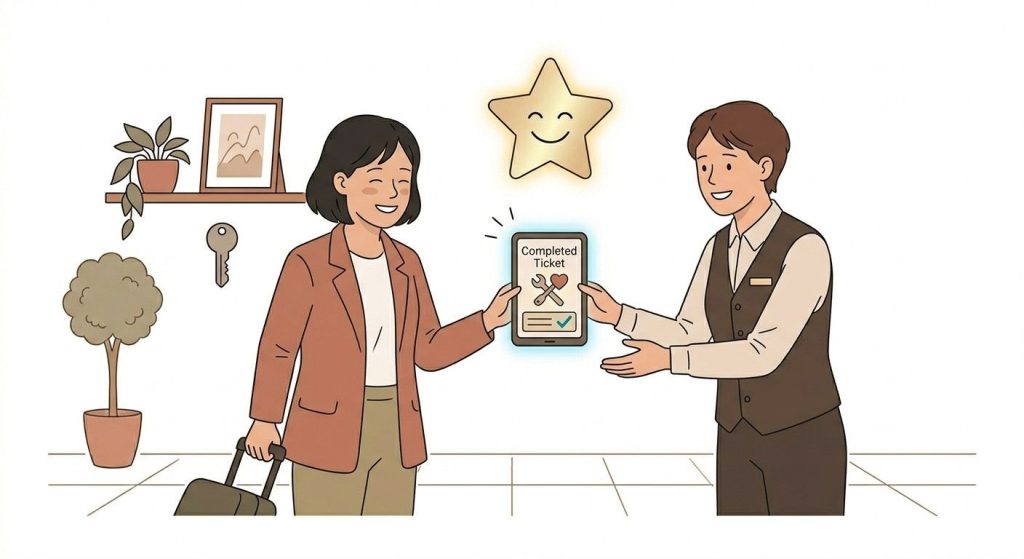
That second number points to something researchers in hospitality have studied for years called the service recovery paradox. The idea is this: a guest who had a problem and watched your team fix it quickly and well will often feel more loyal than a guest whose stay had no problems at all. The recovery itself becomes the memorable moment. It signals to the guest that your team actually cares, not just when everything is going smoothly but also when something goes wrong at 11 PM on a Friday.
Complaints as Loyalty Opportunities, Not Just Damage Control
That is the shift in mindset that separates hotels that dread complaints from hotels that use them. A poorly handled complaint costs you a guest. A well-handled complaint can earn you an advocate.
The Difference Between Lucky and Consistent
The hotels that understand this do not dread guest complaints. They build systems that catch them, route them, resolve them, and turn them into the kind of story a guest tells their friends.
Not because they got lucky with the right staff on the right shift. Because they built a process that works every shift, every time.
Here is a question worth asking your operations team this week: What is your hotel’s average complaint resolution time right now? If no one knows the number off the top of their head, that is the answer. The right complaint management platform makes that number visible, trackable, and improvable from day one. That single metric, once you can see it, tends to change everything about how your team thinks about service recovery.