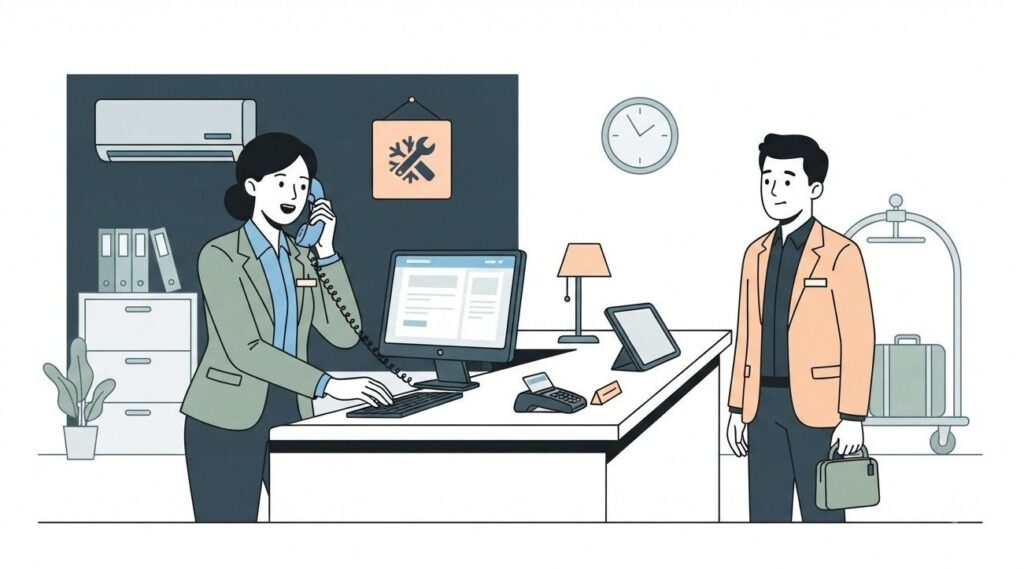
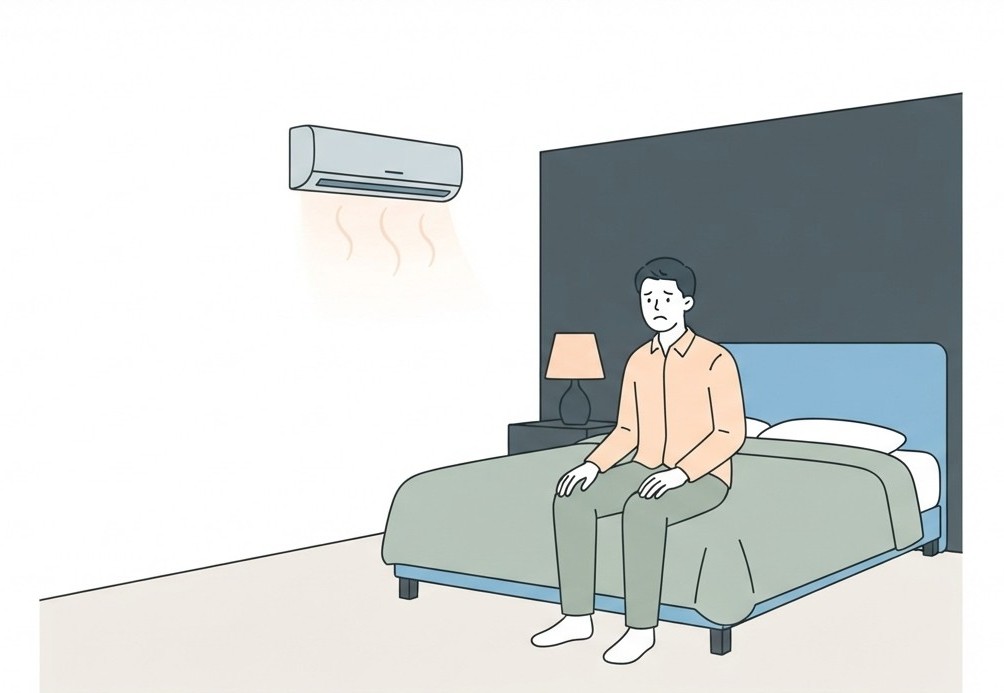
Picture a Tuesday night at 10:15. A guest in room 412 tells the front desk that the air conditioner is barely cooling. The associate says, “I’ll send someone right away.” She means it. Then a late check-in arrives, a phone rings, and her shift ends at eleven.
Nobody writes the request down. As a result, maintenance never hears about it. By morning, the team starts fresh and has no idea that room 412 spent the night too warm to sleep.
At checkout, the guest says the stay was fine. The associate smiles and says thank you. Still, nobody mentions the air conditioner.
The guest does not book that hotel again. The hotel never finds out why, because according to its records, nothing went wrong.
That is the unrecorded moment. It leaves no complaint and no ticket. Often it leaves no review either. Yet it changes how a guest feels about your hotel, and it happens in properties full of good people with good intentions.
Most hotels measure what they can see. This article, however, is about what they cannot, and why it matters more than most managers think.
Guests who say “fine” are often hiding something
Most unhappy guests never tell the hotel. The number you will see quoted most often comes from TARP, a customer research firm that studied complaint behavior for decades. Its findings say that only about one in 26 unhappy customers makes a formal complaint, which leaves roughly 96 percent silent. In addition, TARP reported that 63 percent of customers who have a grievance and say nothing switch to another company without explaining why.
Why do they stay quiet? Some do not want a scene. Some think the problem is too small to raise. Others have learned that complaining changes nothing, an attitude TARP researchers call “trained hopelessness.”
However, treat the numbers with some caution. They are old, and they come from many industries, not only hotels. For example, a hospitality literature review cites a 2001 study by Su and Bowen that put the silent share of dissatisfied customers at 42 percent. Even so, that lower figure means close to half of unhappy customers keep it to themselves.
A request nobody logs is a request nobody owns
Think about where a guest request starts in your hotel. It might be a call to the front desk or a word with a housekeeper in the corridor. Sometimes it is a WhatsApp message to a manager. Each channel works on its own. Together, though, they leave gaps, because no single place holds the request, names who will handle it, and tracks whether the work got done.
Without an owner, a request depends on one person’s memory. Memory, after all, is a weak system at the end of a long shift.
Fast reactions do not fix this. In fact, a 2013 mystery shopping study covering 525 upscale hotel visits found that leading brands responded to problems quickly, then slipped. Staff showed empathy or offered an apology less than 75 percent of the time. Also, many employees solved the problem and never told the guest. The researchers put their conclusion plainly:
“Follow-up is the most critical component of the service recovery process.”
Coyle Hospitality Group, 2013 mystery shopping study
Put yourself in the guest’s seat. A fix that nobody mentions looks a lot like a fix that never happened.
What the research says a missed moment costs
First, look at what guests in India say they want. A 2025 survey of 572 hotel guests in Indian cities, published in the IUJ Journal of Management, asked people to rate what matters most. Round the clock communication ranked first, and speed of guest service ranked second. Loyalty points, meanwhile, ranked last. The respondents came from convenience and snowball sampling in select cities, so the result shows a pattern and not the whole market. Still, guests told researchers they care more about a fast reply than about points.
Small problems guests do not forgive
Next, look at what happens after something goes wrong. Alex Susskind of Cornell surveyed more than 800 restaurant guests and found that people who felt happy with the outcome of their complaint were more likely to say they would return. That study looked at restaurants, so treat it as a close relative of hotel research and not as proof for hotels.
One finding in Susskind’s work should worry hoteliers. Guests rated problems such as noise or atmosphere as the least severe, yet those problems were the most likely to make them decide never to return, even after the restaurant addressed them. In other words, small things carry more weight than staff expect. The air conditioner in room 412 is a small thing.
A hotel can only apologize for what it knows about
Chris Anderson and Saram Han, also at Cornell, add a second angle. They studied three years of survey data from 515 hotels, covering more than 500,000 guests. Guests who shared feedback, good or bad, saw their chance of becoming loyal rise by almost 50 percent, and a response from management pushed that higher. In addition, detailed, personal apologies for a service failure improved satisfaction on later stays. That shows an association, not proof of cause. Still, a hotel can only apologize for what it knows about.
One popular idea needs a warning. The service recovery paradox says a guest whose problem gets fixed well becomes more loyal than a guest who never had a problem. However, the evidence is mixed, and a study of two hotels in Portugal found no sign of it. So do not count on a bonus for fixing things. Count on a penalty for missing them.
What a quiet guest costs you
Loyalty is where the numbers get large. For example, Fred Reichheld and Phil Schefter reported that raising customer retention by 5 percent can lift profits by 25 to 95 percent. The wide range tells you the result changes by industry, so treat it as a direction and not a promise to your owners.
The other side of the ledger is the cost of replacing a guest. Amy Gallo, writing in Harvard Business Review in 2014, put the gap between five and 25 times, depending on the study and the industry. Winning a new guest costs far more than keeping one you already have.
Reputation adds one more layer. Chris Anderson matched online review scores with hotel revenue data and found that a 1 percent rise in a hotel’s online reputation score went with up to 1.42 percent more revenue per available room, built from higher room rates and higher occupancy. Of course, the effect was smaller for luxury hotels, and the study dates from 2012, so use it to see the shape of the effect, not to predict your own numbers.
Now picture the guest from room 412. They do not slam a door. Instead, they write a vague three-star review, or they say nothing and book somewhere else next time. Either way your retention and your rating slip a little, and nobody can trace it back.

Why your own reports will not show you the problem
Look at the reports your team reads each week. They show logged complaints, closed tickets, and review scores. But room 412 appears in none of them.
Few complaints can mean happy guests. They can also mean quiet guests. A report cannot tell the difference, because it only counts what someone chose to record. As a result, a hotel in this position reads its own data as proof that things are fine, and the data has no way to say otherwise.
The warning signs are easy to miss. For instance, the same issue, say a warm room or slow room service, keeps coming up in chats with staff but never shows up in a count. The general manager hears about last night’s problems from a guest at breakfast instead of from the team.
Counting matters here. A hotel with no request log cannot say which problems repeat, which shift handles them slowest, or which rooms cause the most calls. Thus, a hotel that cannot count a problem has no way to fix it for good.

What changes when every request gets a record and an owner
The fix is not more training or more apologies. Instead, it is a way to capture the request at the moment someone speaks it.
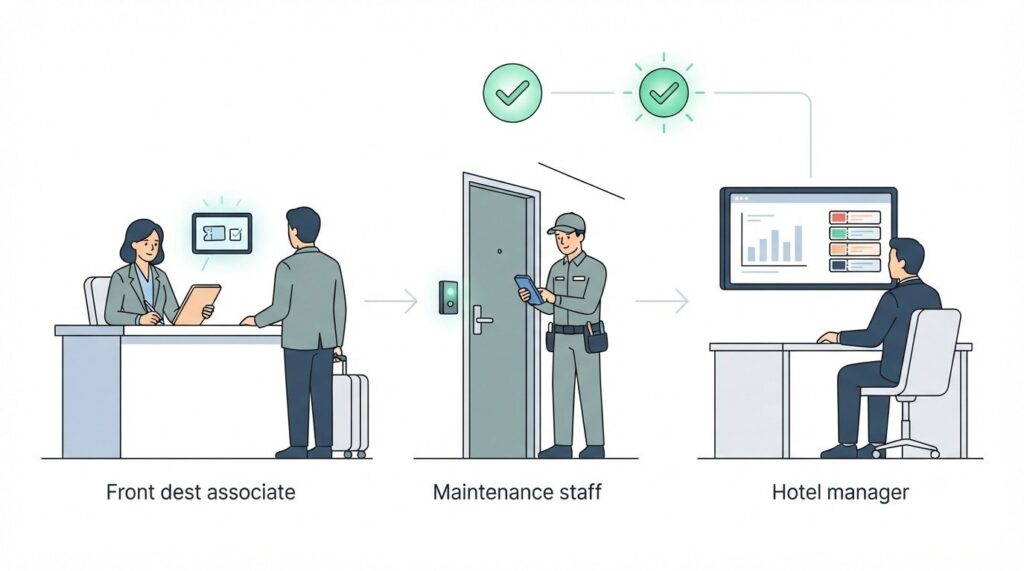
When a request enters a system right then, the picture changes. The hotel has a record. Then the right person gets the job, chosen by department and shift instead of by whoever stood closest. If nobody acts in time, the request moves up to a manager before the guest has to ask twice.
Ease matters as much as the idea. A system that takes two minutes to update will get skipped at 10:15 on a busy night. Staff use a tool that takes seconds, but they drop one that feels like extra paperwork. So hotels need both parts: assignment that happens without anyone deciding, and ticket handling simple enough for every shift.
This is the gap Geedesk, a cloud-based guest request platform for Indian hotels, was built to close, with Automatic Assignment and Ticket Management at its center.
Four questions to ask your team this week
- Where does a guest request live in its first minute?
- Who owns it, by name?
- Who finds out if it stalls?
- Could a manager open yesterday’s list and see every request, including the ones raised after midnight?
If your team hesitates on any of them, a request is probably slipping through somewhere in your hotel right now.
If you would like to see what a logged request looks like, from the front desk to the manager’s screen, book a demo with Geedesk.