The complaint came in at 11:47 PM. A guest on the fourth floor called the front desk to say the air conditioning in their room was making a loud rattling noise. The night manager apologised, sent up maintenance, and the technician tightened a loose panel. The guest thanked them and went to sleep.
Three weeks later, a different guest in the same room made the exact same complaint.
The team had already closed the ticket from the first incident. Someone had marked it resolved and moved on. But the AC unit had a worn compressor bracket that would keep loosening every few weeks until someone replaced it. No one read the first ticket again. The maintenance pattern it pointed to went unnoticed. The bracket stayed in place.
That is the recurrence trap.
Hotels close complaints every day without understanding them. Staff apologise, compensate, and send someone to fix the immediate problem. Then they move on. The ticket status changes to resolved. The complaint disappears from the queue. And the same issue waits quietly for the next guest to discover it.
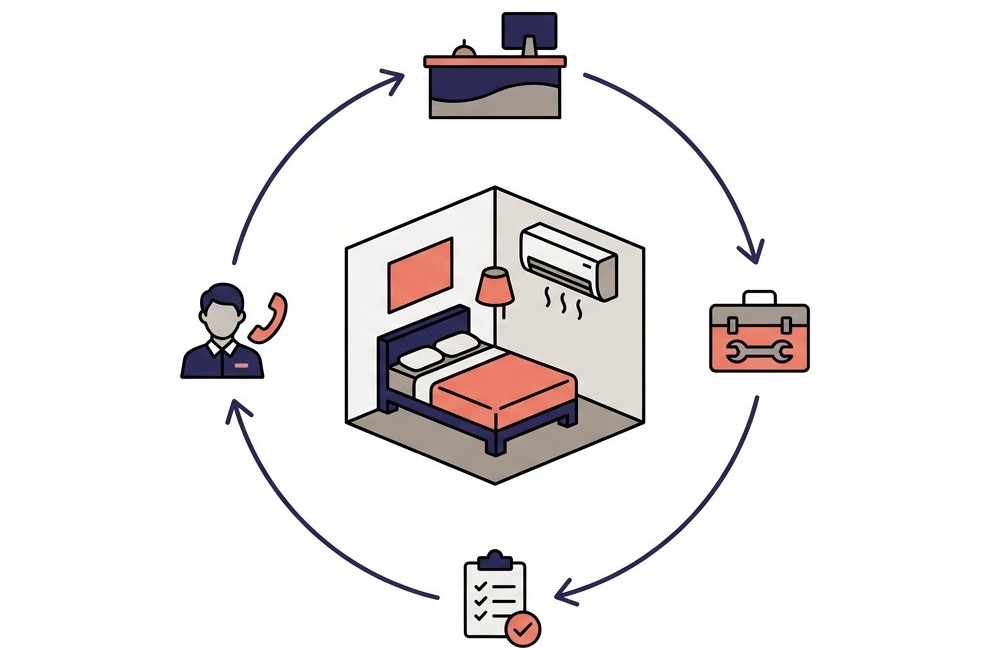
Closing a Ticket Is Not the Same as Closing the Loop
There is a clear difference between making a complaint go away and making sure it cannot come back. Most hotel operations are very good at the first thing and almost never do the second.
Closing a ticket means the guest stopped complaining. Closing the loop means you understood why the problem happened, fixed the root cause, and confirmed that the fix actually held.
These are two different activities. Hotels almost always do the first. They rarely do the second.
The front desk team marks the AC complaint resolved because the guest was satisfied and maintenance attended to it. The maintenance team marks the work order done because the panel is no longer rattling. But no one asked why the panel loosened. No one checked the maintenance history for that unit. No one scheduled a follow-up inspection. So the loop stayed open while the ticket said closed.
This is not a staffing failure. It is a structural one. Most complaint workflows exist to move tickets through a queue, not to capture learning. The moment a guest stops expressing dissatisfaction, the workflow treats the problem as finished. The cause, however, lives on.
The Silent Majority of Dissatisfied Guests
Before examining why hotels stay stuck in the recurrence trap, it helps to understand what the trap actually costs.
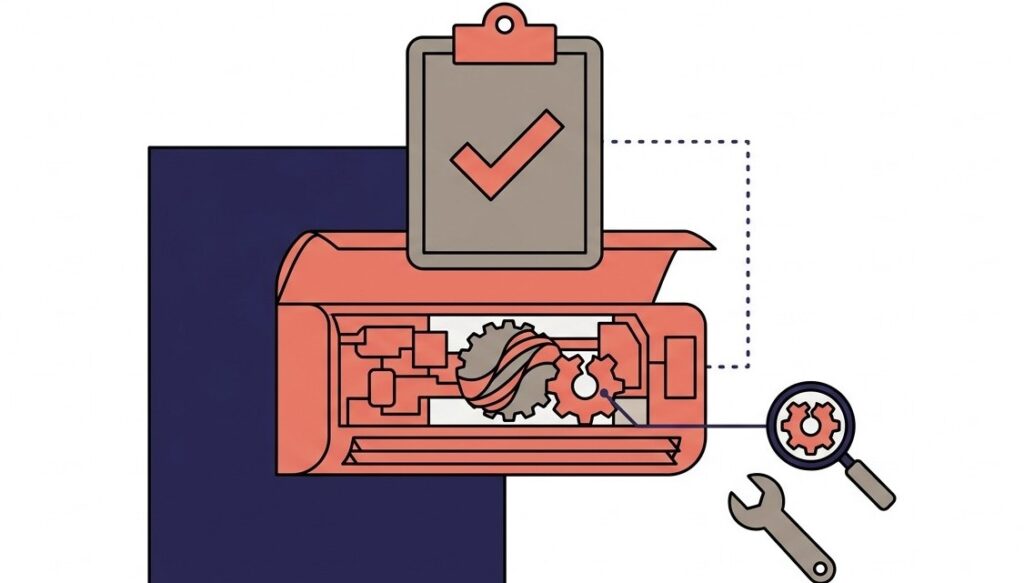
Industry research has found that only 25% of guests report service problems directly to hotels. The other 75% say nothing and later share their frustration through reviews, word of mouth, or simply by not booking again. Moreover, for every guest who does speak up, an estimated 26 others stay silent and leave.
Research from hospitality management institutes puts the number even lower. Only 5 to 10% of dissatisfied guests actually voice their concerns to hotel staff during a stay. The rest absorb the problem, endure the remainder of their visit, and go home with a negative impression the hotel never gets to address.
This means that the complaints reaching your front desk are the visible tip of a much larger problem. Each complaint you receive likely represents several guests who experienced the same issue and said nothing. When the same problem recurs the next month, it affects another set of guests, most of whom will also stay silent and leave quietly.
As a result, the recurrence trap does not just repeat a service failure. It repeats the loss of guests who never told you they were unhappy.
What Genuine Resolution Actually Requires
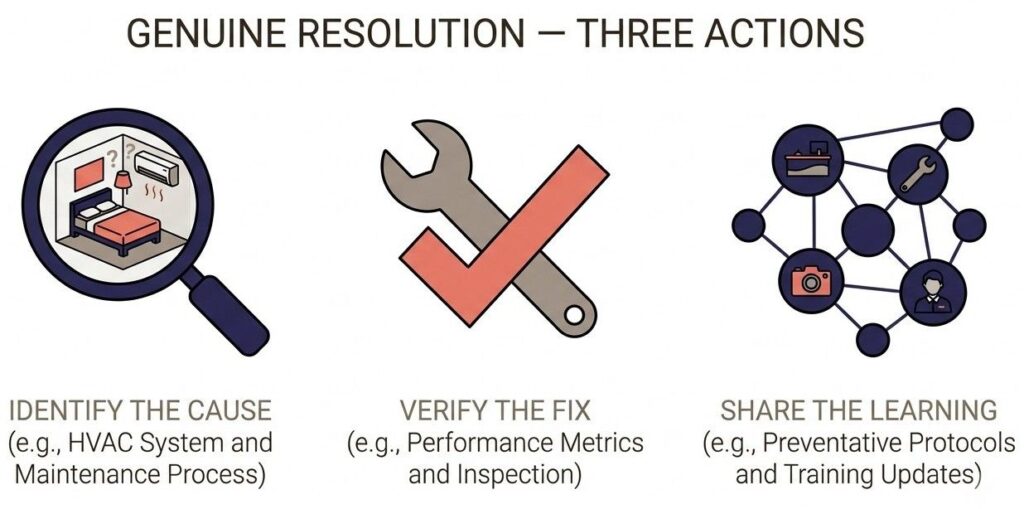
Hotels that break the cycle do three things that complaint-as-ticket operations skip entirely.
They document the cause, not just the symptom.
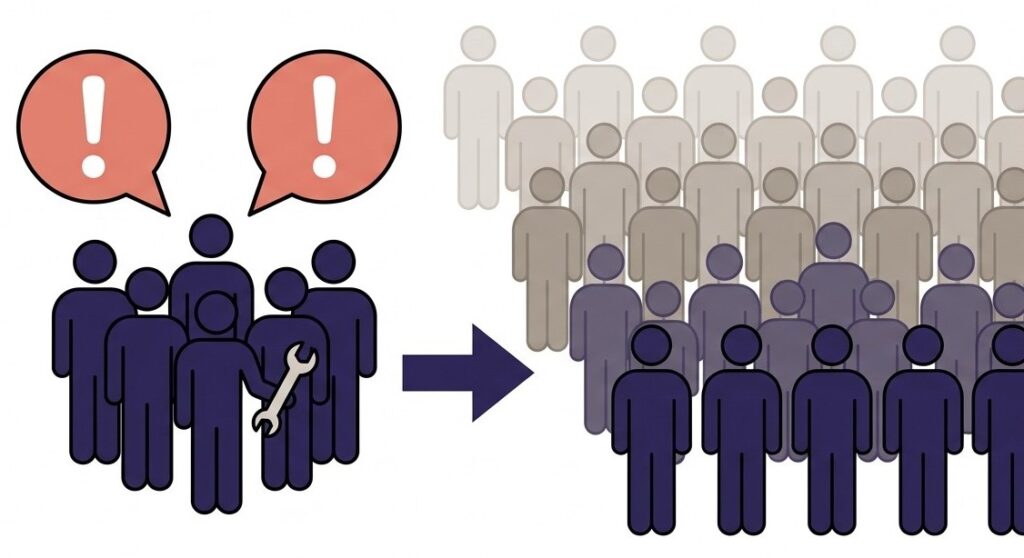
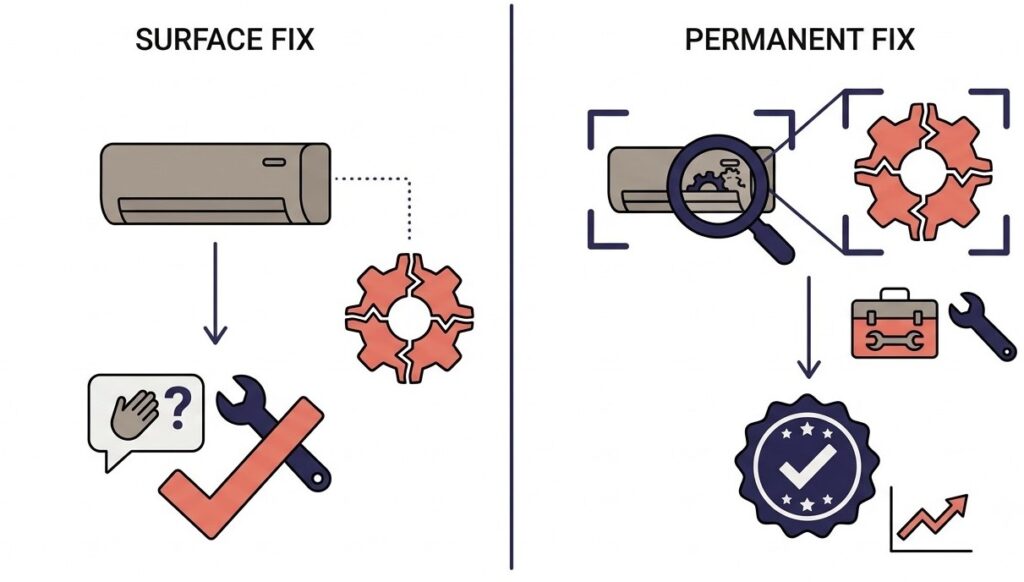
When the AC unit rattles, the symptom is the noise. The cause might be a worn bracket, an overloaded compressor, or a unit that has not had preventive maintenance in 18 months. A ticket that says “noise complaint, AC unit checked” captures the symptom. A complaint record that says “loose compressor bracket, temporary fix applied, root cause pending full inspection” captures the cause.
The difference matters because symptoms repeat. Causes, when correctly identified and addressed, do not.
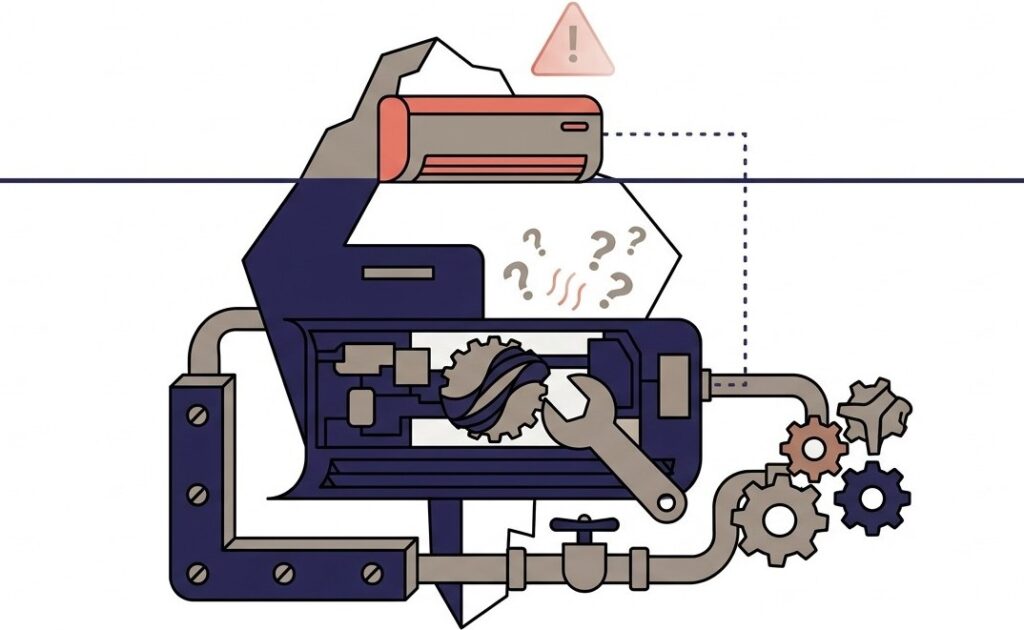
They confirm resolution, not just response.
Response is sending the technician. Resolution is the unit functioning normally three weeks later. Most hotels track the first event and consider the matter closed. Very few track whether the fix actually held. A genuine feedback loop therefore requires a follow-up step, whether that is a scheduled check-in, a maintenance inspection, or a note that triggers a review the next time that room type generates a complaint.
They share the information across departments.
The maintenance team knew the AC unit had a history of problems. The front desk did not. The general manager definitely did not. When teams log complaints as individual events rather than patterns, the information stays isolated. The maintenance team fixes what is in front of them. The front desk handles the next call without context. And neither team has the full picture.
Systemic resolution requires complaint data to flow where decisions get made. A front desk record showing that the same room generated three noise complaints in two months should reach the maintenance supervisor and the operations manager, not just the agent who took the original call.
How Department Silos Feed the Cycle
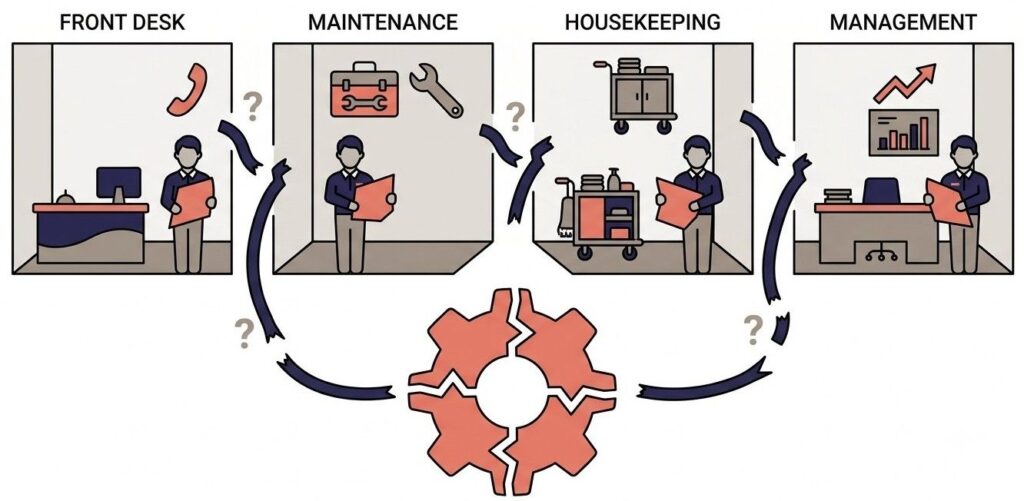
Walk a single complaint through a typical mid-size hotel and watch what happens to the information it carries.
A guest calls the front desk. The agent logs the complaint, dispatches the relevant department, and follows up to confirm the guest has no further concerns. The agent’s job is done well. But the record of that interaction lives in the front desk system. The maintenance team works from their own log. Housekeeping runs their own checklists. Meanwhile, the general manager reviews a summary at the end of the week that smooths out most of the detail.
By the time a recurring problem reaches the person with authority to fix its root cause, it has already repeated itself several times across several different departments, none of whom had the full picture.
This is what a complaint silo looks like. Each department handles the piece of the problem that arrives at their door. No one holds the whole thread. No one owns the question of why this keeps happening.
The result is a kind of institutional amnesia. The hotel has experienced the problem before. Multiple staff members across multiple shifts have dealt with it. But that experience sits scattered across systems, logs, and individual memory. When the same complaint arrives again, it lands in a team that has no easy way to know whether this is the first time or the fifth.
Effective complaint management therefore requires one place where the full history of an issue lives, reachable by the departments responsible for resolving it. Without that, each team handles its incident in isolation and the pattern that could prompt a permanent fix never surfaces.
Why Hotels Default to Surface Fixes
The pressure is real and the logic is understandable. A guest is unhappy right now. The priority is making them happy right now. In that moment, root cause analysis is not what solves the problem. An apology, a room change, and a complimentary amenity do.
The issue is that hotels apply this short-term response pattern even when there is no immediate guest to pacify. Once the team closes the complaint, the urgency disappears, and with it any incentive to investigate further.
Several structural factors reinforce this pattern.
Most hotels keep complaint records separate from maintenance logs, housekeeping schedules, and operations data. When the front desk marks a complaint resolved, that record rarely travels to the department responsible for the underlying issue. The maintenance team fixes the immediate problem without seeing the complaint history. The front desk receives the next complaint without seeing the maintenance history. Each team, as a result, works with an incomplete picture.
Staff turnover also plays a significant role. When the front desk agent who handled the original complaint is no longer on shift, their institutional memory of that incident is gone. If no one documented the complaint in detail, the pattern it represents stays invisible to the next person who encounters the same issue.
Beyond that, complaint analysis, when it happens at all, usually happens on a lag. Weekly reports, monthly reviews, and quarterly audits are too slow to catch the kind of recurring operational problem that surfaces every few weeks. By the time the pattern appears in a report, several more guests have already experienced it.
The Feedback Loop That Actually Prevents Recurrence
Preventing recurrence is an operational question, not a service recovery question. It requires a different process than the one hotels use to handle complaints in the moment.
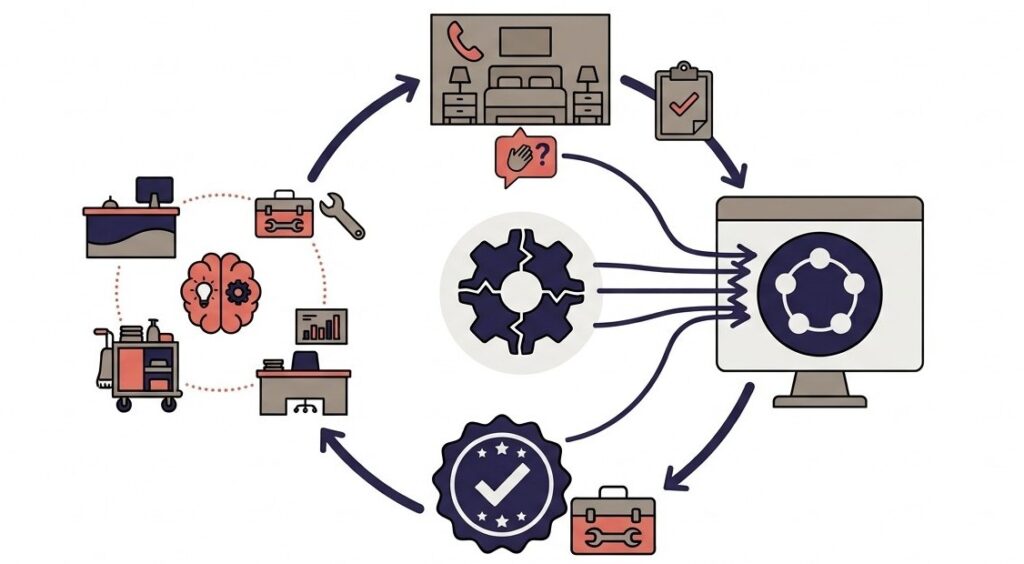
A feedback loop that actually works has four components.
Log the Cause, Not Just the Complaint
Staff need to log complaints with enough detail to be useful later. That means recording the location, the specific issue, who responded, what action they took, and whether that action addressed the symptom or the root cause. A log that says “room 412, cold food” is not actionable. A log that says “room 412, cold food reported, traced to hold time at kitchen pass, flagged to F&B supervisor” gives the next person something to work with.
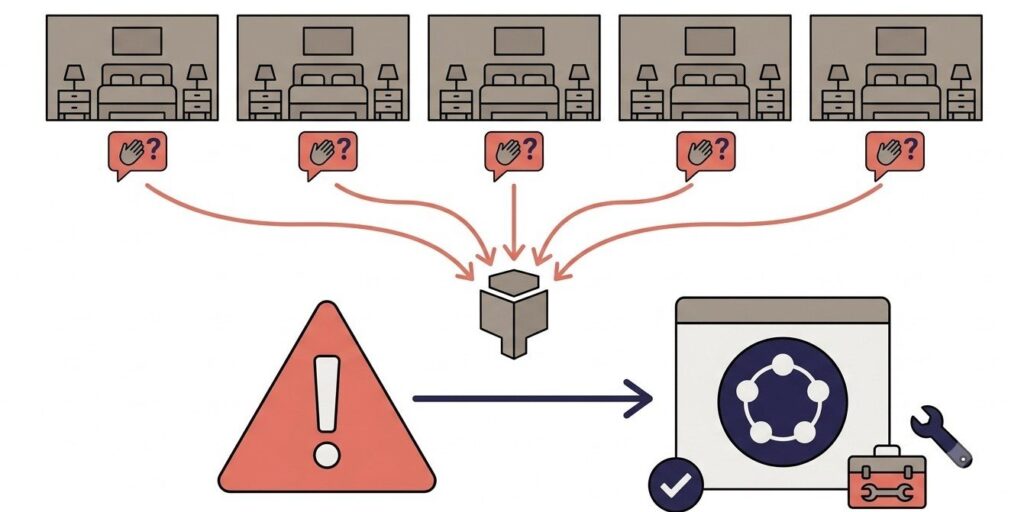
Make Patterns Visible in Real Time
Patterns need to be visible in real time, not in arrears. If the same room type generates housekeeping complaints three times in a week, the operations manager needs to see that now, not in next month’s summary. Pattern visibility is what converts complaint data from a historical record into an operational signal.
Verify the Fix, Not Just the Response
Resolution needs active verification, not assumption. Someone must confirm the fix worked before the team fully closes the complaint. For a maintenance issue, that might mean a follow-up inspection. For a service failure, it might mean a check-in note the next time that guest stays. This verification step is what turns a response into a genuine resolution.
Share the Learning Across Departments
The learning needs to travel across teams. When someone identifies the root cause, the relevant departments need to know about it and have a clear owner responsible for the preventive action. A complaint about slow housekeeping that traces back to a scheduling gap should reach the housekeeping supervisor, not just sit in the front desk log.
This is not a complicated process. It is a consistent one. And consistency is exactly what most hotels do not have when it comes to complaint follow-through.
What the Data Tells Us About Getting This Right
Hospitality research has found something that runs counter to the instinct most hoteliers have about complaints. Guests whose complaints hotels resolved effectively often became more loyal than guests who never experienced a problem at all.
The phrase for this is the service recovery paradox. A handled complaint, handled well and handled completely, can produce a stronger guest relationship than a smooth stay. The problem is that “handled well” requires more than a satisfied guest at checkout. It also requires the same guest to encounter a different experience on their next visit because the hotel actually changed something.
That change is what most hotels skip. They recover the guest in the room. They do not change the operation that failed the guest in the first place.
Studies on traveler review behavior show that 48% of guests write reviews after a negative experience, compared to 40% after a positive one. Guests who encountered a problem that hotels never really fixed are more likely to document that experience publicly than guests who had a good stay. So the recurrence trap is not just an operational problem. It shows up directly in online reputation.
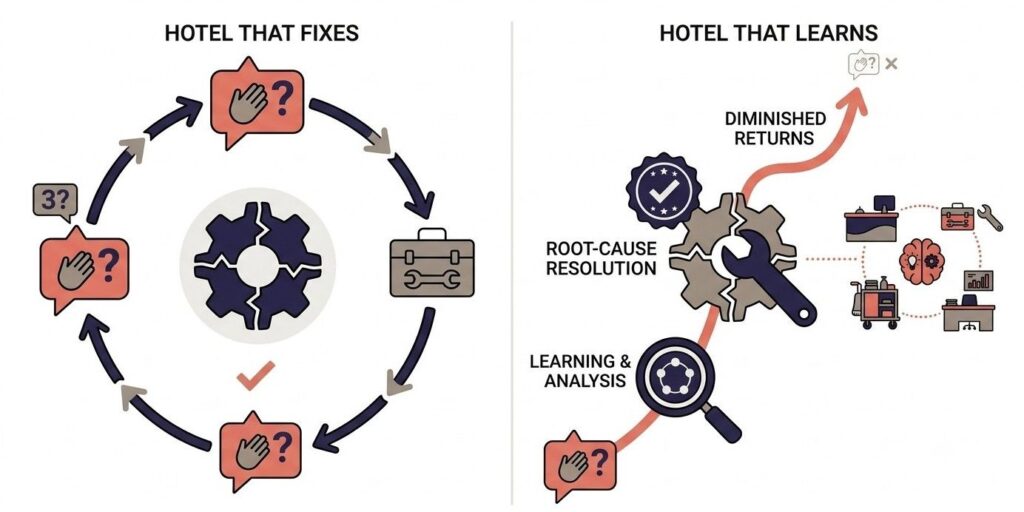
The Difference Between a Hotel That Fixes and a Hotel That Learns
The distinction that separates hotels that break the recurrence trap from those that stay in it is not the quality of their initial response. It is whether the complaint changes anything about how the hotel operates after the guest leaves.
A hotel that fixes responds to each complaint as an isolated event. The guest leaves happy, the ticket closes, and operations continue as before. When the same complaint comes in again, the team treats it as a new event.
A hotel that learns treats each complaint as data. The guest leaves happy, the team documents the root cause, someone tracks the pattern, and the relevant department gets notified. When no similar complaint comes in for the next three months, that absence is also tracked. It confirms the fix worked.
The first model produces good complaint scores in the short term. The second model reduces complaint volume over time.
Most hotels operate the first model because it is faster, easier, and requires less coordination across departments. In contrast, the second model requires better documentation, better data visibility, and a deliberate process for converting complaint records into operational changes.
The gap between these two models is where the same complaints keep coming back.
Breaking the Cycle
The recurrence trap is not inevitable. Hotels that treat complaints as operational intelligence rather than service events to resolve, close, and forget tend to see fewer repeat complaints over time. Not because their operations are perfect, but because each complaint leaves the operation slightly better than it was before.
That shift requires one thing more than anything else: a complaint workflow that does not end when the guest stops complaining.
Closing the ticket is the beginning of the process, not the end of it.
If your team is still solving the same complaints month after month, it is time to look at how your complaint workflow actually works. [Book a demo.]