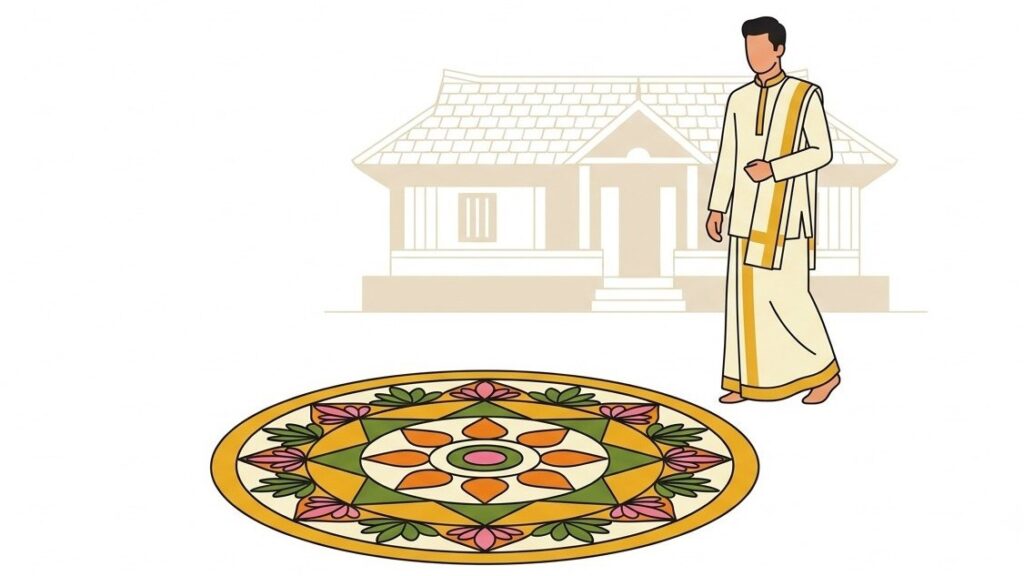
Every year, around late August or early September, the Indian state of Kerala slows down for ten days. Offices close. Meanwhile, families travel home. People lay flowers on their doorsteps every morning and sit down to a feast served on a banana leaf. This is Onam, the biggest festival in Kerala and one of the most colourful celebrations in India.
If you have never heard of it, think of a harvest festival, a family reunion, and a homecoming for a beloved guest, all happening at once. Every culture has a version of the first two. However, the third is where Onam becomes its own thing.
The story of a king who was too good for the gods
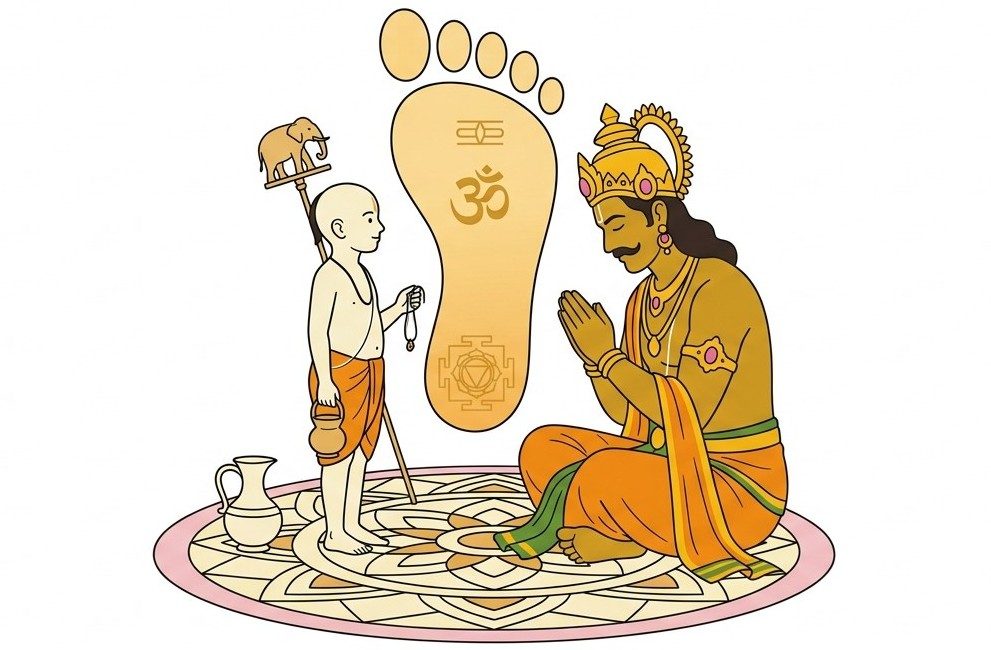
Onam begins with a legend. Long ago, Kerala had a king named Mahabali, known fondly as Maveli. He belonged to the asuras, the race that Hindu mythology usually paints as demons. Even so, Mahabali ruled with such fairness and generosity that his people wanted for nothing. Old Malayalam folk songs describe his reign as a time when everyone was equal, no one cheated, and no one went hungry.
His popularity worried the gods. So Vishnu, one of the main Hindu deities, took the form of a small Brahmin boy called Vamana and visited the king. Mahabali, famous for never refusing a request, asked the boy what he wanted. Vamana asked for only three paces of land. So the king agreed at once.
Then Vamana grew until he filled the sky. With his first step he covered the earth. With his second he covered the heavens. When he asked where to place the third, Mahabali bowed and offered his own head. Vamana pushed him down to the netherworld.
Because the king had kept his word without hesitation, Vishnu granted him one wish. In turn, Mahabali asked to visit his people once a year. Onam is that visit. On the final and most important day, Thiruvonam, Malayalis believe Mahabali walks through every home in Kerala to see that his people still live well.
That is why the whole festival feels like preparing for a beloved guest. First you clean the house, then you dress up, cook your best food, and finally put flowers at the door.
When Onam falls and why the date moves
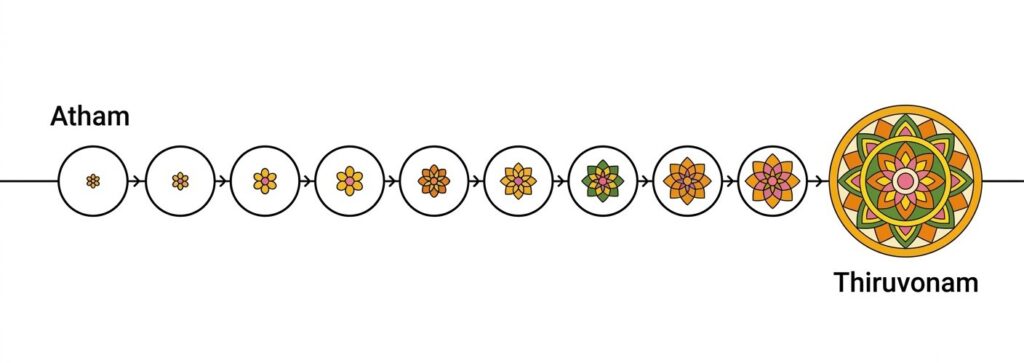
Onam follows the Malayalam solar calendar, not the Gregorian one. It falls in the month of Chingam, the first month of the Malayalam year, which usually lands between mid August and mid September.
The festival runs for ten days. Specifically, it starts on the day called Atham and ends on Thiruvonam. Each day takes its name from a star in the traditional calendar, which is why the exact dates shift every year and why two websites can print two different answers. For that reason, check a current Malayalam calendar before you plan a trip. The Kerala government declares a cluster of public holidays around the main day, and the days after Thiruvonam carry their own names and customs too.
The flower carpet that grows every morning
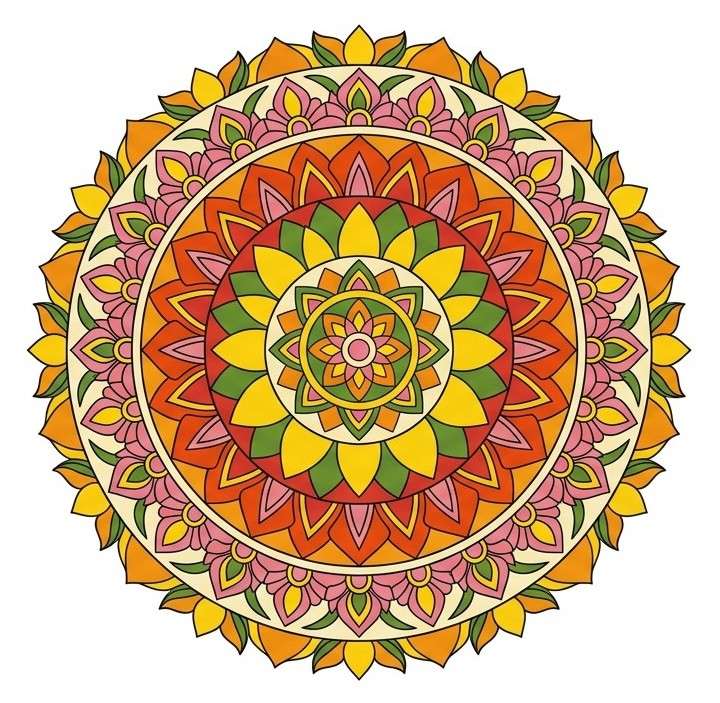
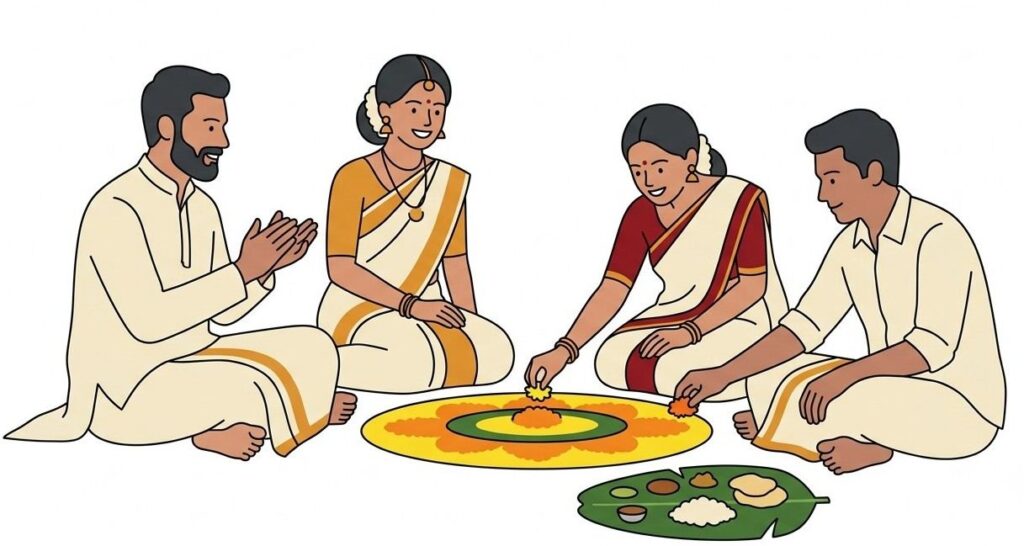
Walk through any neighbourhood in Kerala during Onam and you will see circular designs made of flower petals on the ground outside homes, schools, and offices. This is the pookalam, a flower rangoli.
Rangoli, if you have not seen one, is the Indian tradition of drawing patterns on the floor at the entrance of a home. In most of India people use coloured powder or rice flour. In Kerala, during Onam, they use fresh flower petals instead.
On Atham, the first day, people lay a small circle using only yellow flowers. After that, each morning they add a new ring and new colours. By Thiruvonam, the design can stretch across several feet and use a dozen kinds of blooms, from marigold and chrysanthemum to hibiscus and jasmine.
Instead, families make it fresh each day, often before breakfast. Children pick flowers, grandparents supervise the pattern, and neighbours compare their work. Colleges and offices hold pookalam competitions with serious rivalries. The point is to build a welcome for the king, one petal at a time.
In many homes, small clay pyramids called Onathappan sit in the centre of the flower carpet. These represent Vamana and Mahabali, and they mark the point where the home officially receives its guest.
The feast on a banana leaf
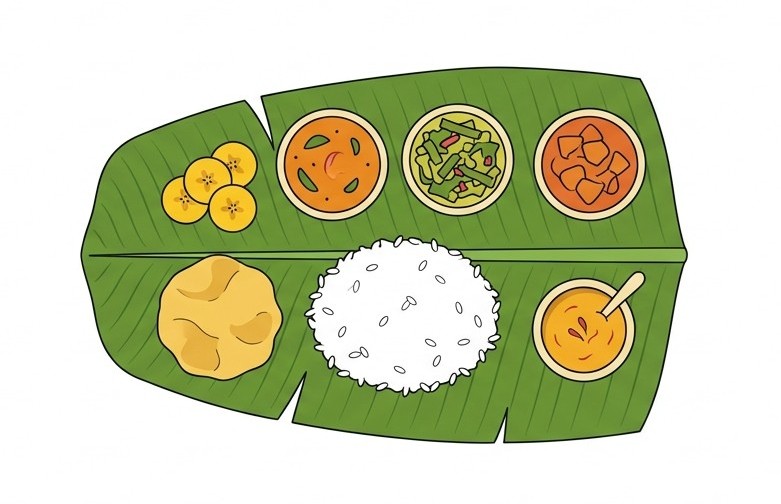
If you ask a Malayali what they love most about Onam, most will say the sadya without hesitation.
The Onam sadya is a fully vegetarian meal served on a fresh banana leaf. A traditional spread includes somewhere between 20 and 30 dishes, and every dish has its own fixed spot on the leaf. Salt goes at the top left, while pickles and banana chips sit near it. Rice fills the centre, and the curries spread across the leaf in a set order.
Some of the dishes you will find:
- Avial, a thick mix of vegetables cooked with coconut and yogurt
- Sambar, a lentil and vegetable stew with tamarind
- Olan, ash gourd and beans cooked gently in coconut milk
- Thoran, dry stir fried vegetables with grated coconut
- Erissery, pumpkin or yam with beans in a spiced coconut paste
- Pachadi, a sweet and sour yogurt dish
- Sharkara varatti, banana chips coated in jaggery
- Pappadam, crisp lentil wafers
Finally, the meal ends with payasam, a sweet pudding. In fact, there is usually more than one kind, made from rice, lentils, or vermicelli cooked in milk or jaggery. Last of all comes a small serving of rice with buttermilk to settle the stomach.
You eat with your right hand, sitting on the floor or at a long table. Servers walk down the row with buckets and ladles, offering second and third helpings as well. You can refuse. Refusing convincingly is harder.
Restaurants across Kerala and in cities with large Malayali populations, from Dubai to London to Houston, book out days ahead for sadya. As a result, families who cannot cook the full meal order it from caterers.
New clothes, old games, and a tiger dance
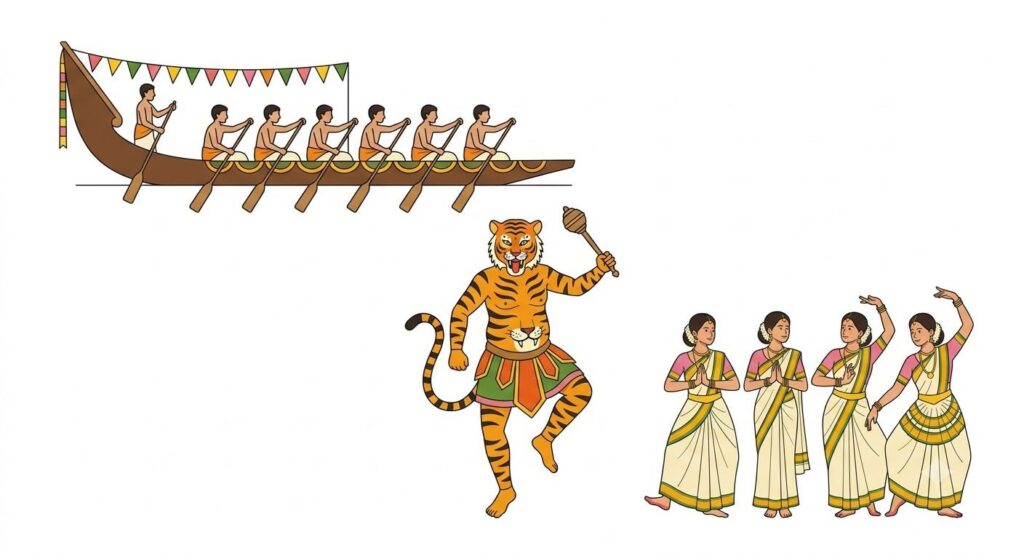
Onam has roots in Hindu mythology, but in Kerala it does not work like a religious holiday. For example, Christian and Muslim families cook sadya, lay pookalams, and buy new clothes just as Hindu families do.
Schools and offices celebrate it together regardless of who works there. The state government promotes it as the official state festival, and Kerala Tourism runs a week of cultural events in Thiruvananthapuram, the capital.
This is partly because Onam is also a harvest festival. Chingam arrives after the heavy monsoon rains, when the rice fields turn gold and the first crop comes in.
Farmers have celebrated this season for centuries, long before the festival took its current form. Later, the story of Mahabali gave the harvest a shared meaning: a time when everyone had enough, and a king who cared whether they did.
That meaning still shapes how people see the festival. Malayalis who live abroad, and there are millions of them across the Gulf, North America, Europe, and Australia, treat Onam as the day they most miss home. So associations in these cities organise sadya lunches and cultural shows, sometimes weeks after the actual date, so that everyone can attend.
A festival that belongs to everyone
Onam has roots in Hindu mythology, but in Kerala it does not work like a religious holiday. For example, Christian and Muslim families cook sadya, lay pookalams, and buy new clothes just as Hindu families do. Schools and offices celebrate it together regardless of who works there. The state government promotes it as the official state festival, and Kerala Tourism runs a week of cultural events in Thiruvananthapuram, the capital.
This is partly because Onam is also a harvest festival. Chingam arrives after the heavy monsoon rains, when the rice fields turn gold and the first crop comes in. Farmers have celebrated this season for centuries, long before the festival took its current form. Later, the story of Mahabali gave the harvest a shared meaning: a time when everyone had enough, and a king who cared whether they did.
That meaning still shapes how people see the festival. Malayalis who live abroad, and there are millions of them across the Gulf, North America, Europe, and Australia, treat Onam as the day they most miss home. So associations in these cities organise sadya lunches and cultural shows, sometimes weeks after the actual date, so that everyone can attend.
How to experience Onam if you are visiting
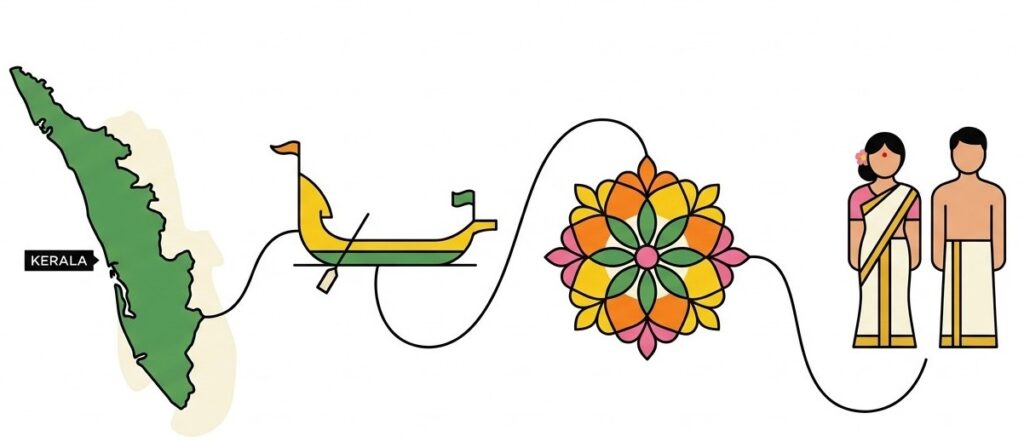
If you plan a trip to Kerala during Onam, a few tips will help.
Book early. Flights, trains, and hotels fill up quickly because so many people travel home. Likewise, prices climb in the days just before Thiruvonam.
Eat a sadya at least once. Hotels, temples, and community halls serve it on the main day. Besides that, many restaurants run sadya menus through the whole week. Go hungry.
Watch a boat race if the timing works. Check the schedule for the Nehru Trophy race in Alappuzha or the Aranmula race in Pathanamthitta district, since they do not always fall on the festival days themselves.
Head to Thrissur for Pulikali. It takes place on the fourth Onam day and is worth the detour.
Expect some closures. Government offices, banks, and many shops shut for the public holidays. Tourist attractions mostly stay open, but even so, confirm ahead.
Dress the part if you like. Locals enjoy seeing visitors in a kasavu sari or mundu, and shops sell affordable versions everywhere.
Why a whole state plays a lost kingdom for ten days
Strip away the flowers and the feast, and Onam comes down to one idea. A good ruler once made sure that everyone in his land lived well. He lost his kingdom because of it. Yet he still comes back every year to check on his people.
Nobody wants him to find things worse than he left them. Therefore neighbours share food, families reunite, doorsteps bloom, and for one long afternoon on a banana leaf, everyone eats like a king is watching.
Happy Onam from all of us
Onam is the busiest week of the year for many hotels in Kerala, and it is also the one where guests expect the most. After all, full occupancy, sadya service, and families arriving from around the world land at once.
To every hotelier, front office team, and housekeeping crew working through this season, and to everyone laying a pookalam at home, all of us at Geedesk wish you a happy Onam. May your guests, like Mahabali, find everything just as it should be.