“We will revisit next quarter.”
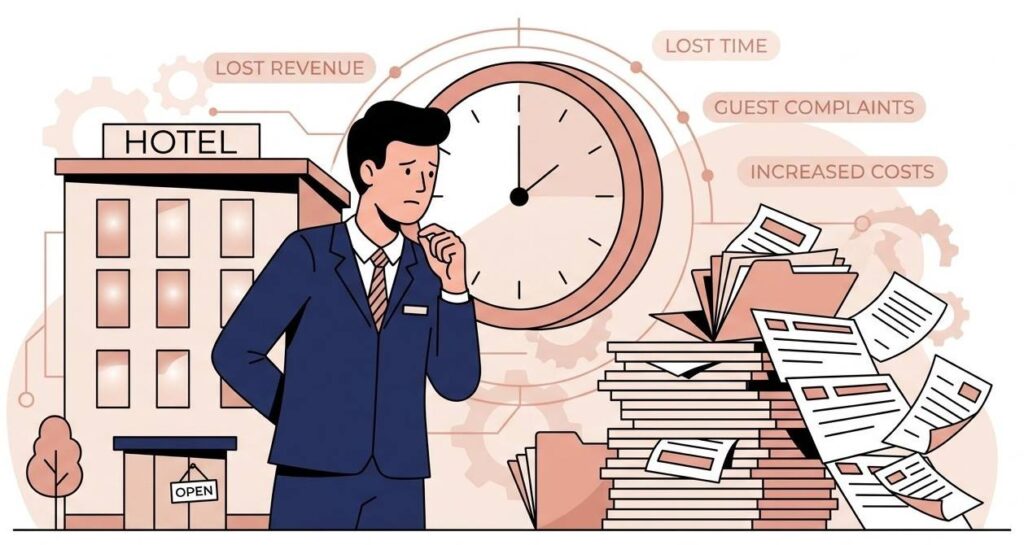
Every general manager has said this about a software decision. Most mean it. The demo went well and the pricing looked fair. But the third floor renovation needs attention, the F&B manager just resigned, and the owners want the budget presentation first. So the decision waits.
The problem is that the cost of running your hotel on WhatsApp groups, phone calls, and memory doesn’t sit still while you wait. It compounds, quietly, in ways that never appear as a line item on anything you sign off.
Here’s what twelve months of “next quarter” looks like.
Months one to three: the leak nobody measures
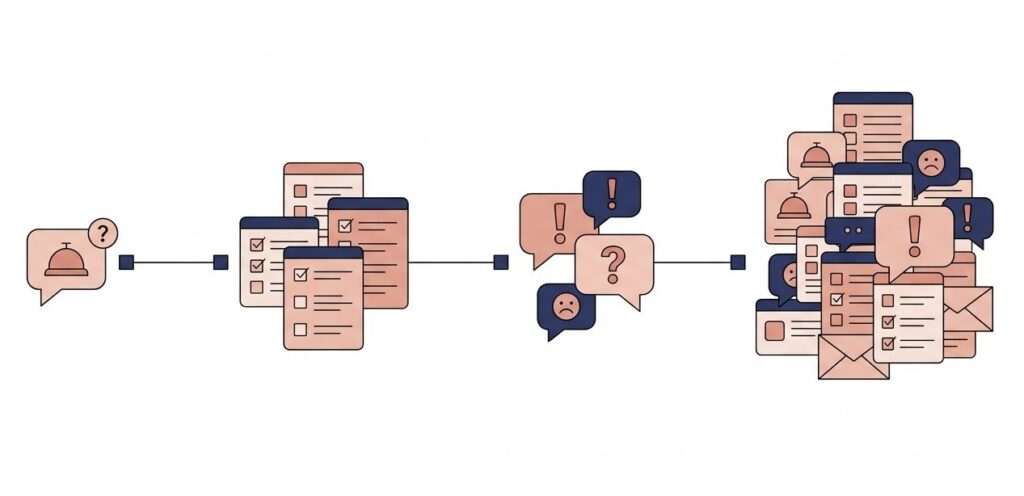
A guest in room 214 asks for extra pillows at 9:40 pm. The front desk agent types it into the housekeeping WhatsApp group. Within an hour, forty more messages bury it. Nobody owns it, so nobody closes it. The guest calls again at 11 pm, now irritated. Someone finally walks the pillows up.
None of this gets recorded anywhere. Nobody knows it happened twice, or that it took ninety minutes. Tomorrow it happens again with a different room, and nobody sees the pattern.
This is the baseline leak. A single missed request costs you a slightly annoyed guest. Thirty a month cost you something harder to see: a property where slow response is normal and nobody can prove otherwise. Without assignment or timestamps, every request lives or dies on whether one person happened to read one message at the right moment.
In these first three months, the damage stays mostly internal. Your team absorbs it and covers for the system with effort. That works for a while. It won’t work for a year.

Months four to six: the review gap opens
Around month four, the gap between you and the property across town starts showing up where bookers can see it.
Reviews are a lagging indicator of operations. A guest who waited twice for pillows won’t always mention pillows. They write “service was slow” or drop a star without explaining why.
The revenue impact of this gap isn’t a guess. Cornell’s Center for Hospitality Research studied the link between reputation scores and hotel performance. A hotel that raises its review score by one point on a five point scale can charge 11.2 percent more and hold the same occupancy. And a one percent improvement in a hotel’s online reputation score leads to as much as a 1.42 percent increase in RevPAR. You can read the full report on Cornell’s research repository.
Run that math against your own RevPAR and room count, and ask what even half a review point is worth across a year. For most mid-size properties, the answer is larger than the annual cost of the software being postponed.
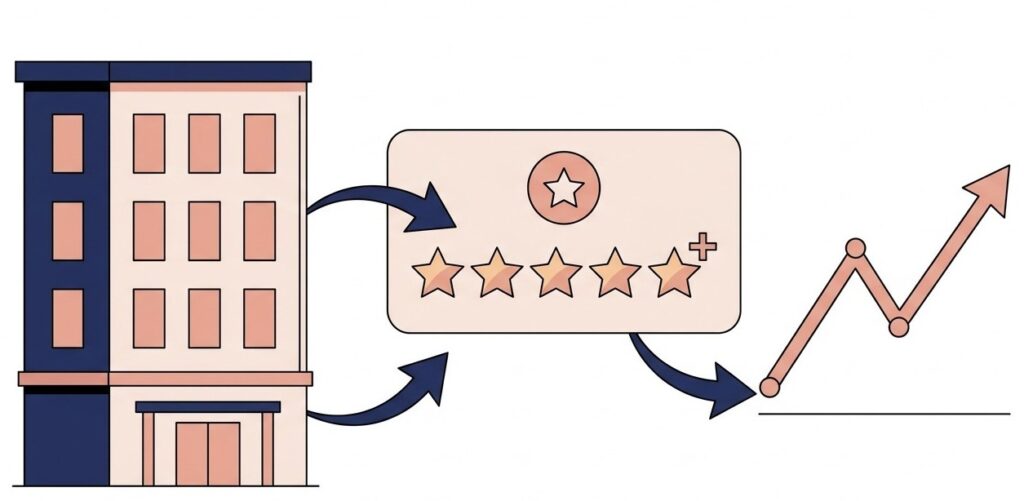
Now flip it. While your requests sit in a group chat, theirs get assigned automatically the moment they come in. Their escalation rules push an alert over SMS, WhatsApp, or the mobile app when something sits too long. Their GM opens a dashboard each morning and sees exactly which requests ran late yesterday. None of this is heroic. It’s just structure. But structure shows up in reviews, and reviews show up in rate.
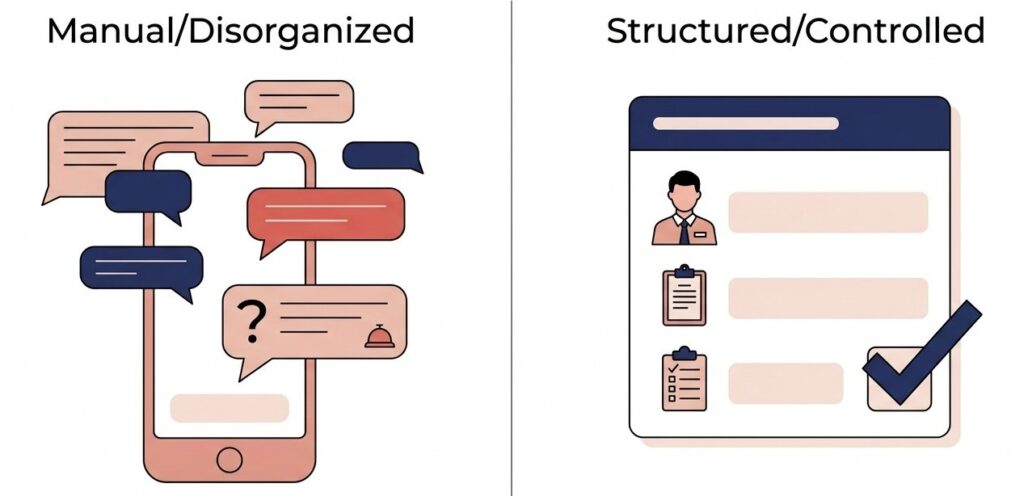
The gap widens every month you wait, because reviews compound. A five star review written in month four is still convincing bookers in month fourteen. So is the two star one.
Months seven to nine: your best people stop fighting the system
This is the cost nobody puts in a spreadsheet, and it might be the most expensive one.
Think about who suffers most when processes are broken. Not your weakest staff. Your strongest ones. The front office supervisor who actually chases every request. The housekeeping lead who keeps her own notebook because she stopped trusting the group chat. These people care, which is exactly why broken systems wear them down fastest.
By month seven or eight, something shifts. The supervisor who used to flag every dropped request stops flagging them. Not because the drops stopped. Because she reported the same problem five times and nothing changed. Complaining started to feel like the problem, so she went quiet. Quiet isn’t the same as fine.
Then the resignations start. Exit interviews will say “better opportunity” or “closer to home.” What they rarely say out loud is “I was tired of being blamed for misses that were never assigned to anyone.” Hospitality has always run high on turnover, and pay usually gets the blame. But talk honestly with people who leave good properties and a different theme comes up: being set up to fail every single shift.

Each departure costs you a hiring cycle, plus months of service dips while the replacement learns the property. Worse, the people most likely to walk are the ones holding your broken process together. When they go, the leak gets bigger and the review gap accelerates.
Months ten to twelve: the gap becomes the culture
By the end of the year, the delay has hardened into something more stubborn than a backlog.
Your team has now spent twelve months learning that requests get lost and that reporting problems changes nothing. New hires absorb this in their first week. It becomes “how we do things here.” Undoing a year of learned workarounds takes far longer than the original rollout would have taken.
Meanwhile the property that moved a year ago has twelve months of data you don’t have. They know their average resolution time by department, and which recurring complaints point to a maintenance problem rather than a service one. Their reports tell them whether last month was better than the month before. You are still reconstructing incidents from memory and scrolled-back chats.
And the pricing power gap is now real money. Their review trajectory and yours diverged months ago, and the Cornell numbers tell you what that divergence does to ADR and RevPAR. They’re not winning because their staff care more than yours. They’re winning because their staff work inside a system that catches what people drop.
The objection that keeps the delay alive
“But we manage fine without it.”
This is the sentence that protects the delay, and it deserves a straight answer. You do manage. Hotels ran for a century before ticketing software existed. The question was never whether you can survive on chats and phone calls. It’s what surviving that way costs, now that your competitors run the alternative.
There is also a quieter version of the objection: “our team will resist a new system.” The resistance argument gets it backwards. The people expected to resist are the same people currently drowning in group chats and taking the blame for unassigned requests. Give them a system where every request has an owner and a clock, and most stop resisting within weeks, because for the first time the record protects them instead of exposing them.
And then there is timing. There will always be a renovation or a resignation that makes next quarter look easier. Waiting for a calm quarter in a hotel means waiting for something that doesn’t exist. The properties that moved did not have calmer quarters than yours. They decided during a normal, messy one.
What “next quarter” is actually costing you
Add it up honestly. Lost and repeated requests that never get counted. A review gap that compounds and prices itself into your rate. Trained staff walking out the door for reasons no exit interview captures.
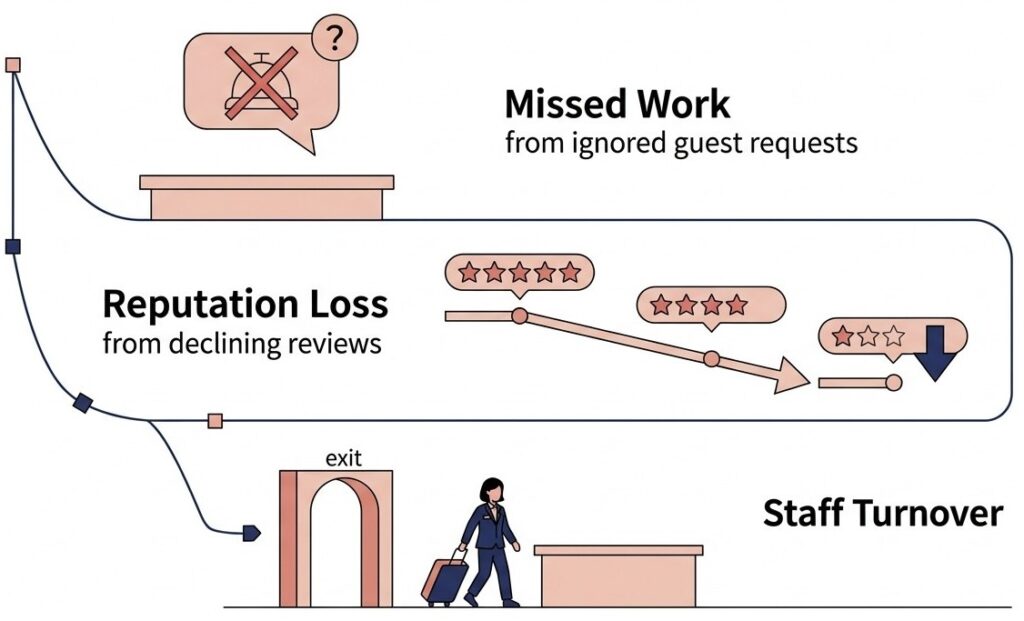
None of these costs send you an invoice. That’s what makes the delay feel free. But the property across town is not waiting, and every quarter you postpone is a quarter of reviews and staff goodwill they bank and you do not.
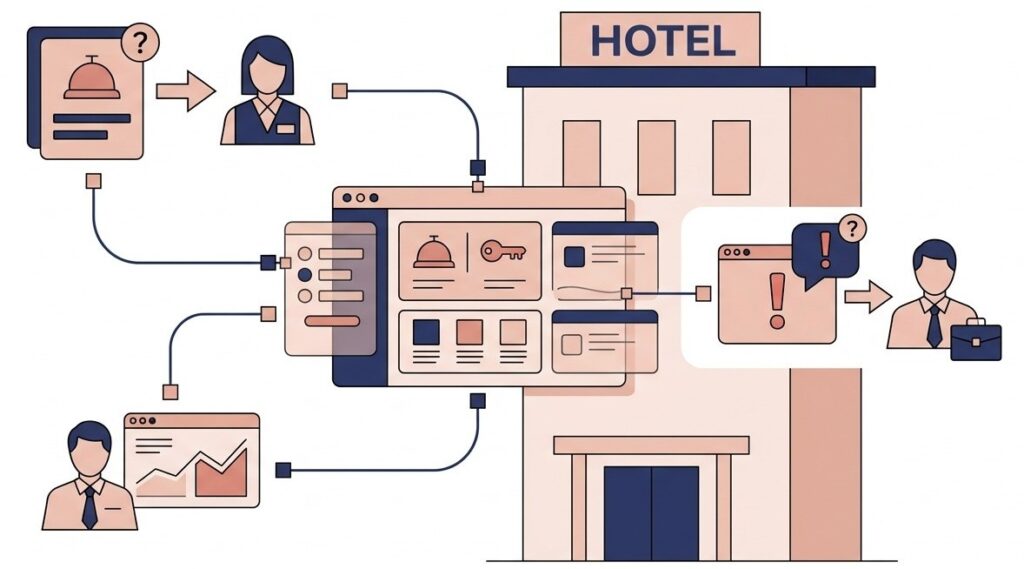
The decision you are postponing takes less time than you think. Geedesk runs entirely on the cloud, so there’s no hardware to install and no server room project to schedule. Requests and complaints get assigned automatically from day one. Escalation policies, VIP alerts, and dashboards for your GM and department managers come built in, and it connects with systems hotels already run, including Oracle Opera, WinHMS, and IDSNext.
You already know the operational holes in your property. You see them every week. The only real question is whether you want to still be seeing them four quarters from now.
Book a demo with Geedesk. Bring your hardest operational problem to the call, and see exactly how the platform would have handled last week’s worst dropped request. That is a better use of thirty minutes than another quarter of waiting.