
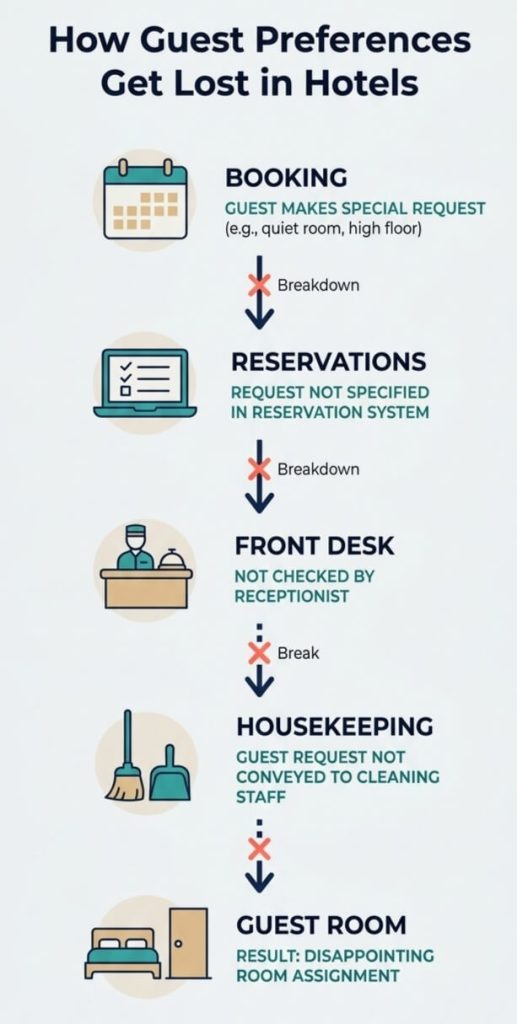
Picture this. A guest books a room three weeks in advance. She notes her preferences clearly: high floor, away from the elevator, foam pillow. She does not call to confirm. She trusts the system.
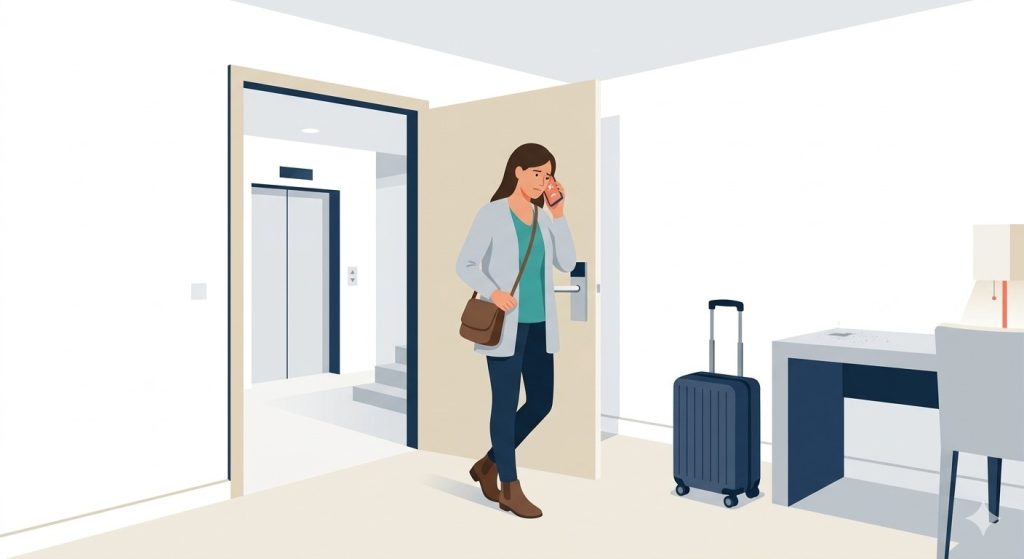
She arrives after a six-hour flight, collects her key card from a smiling agent, and takes the elevator to the fourth floor. The room sits directly opposite the elevator bank. A feather pillow rests on the bed, no note, no acknowledgement, and nothing.
She calls the front desk. She waits four minutes on hold. Someone eventually delivers a foam pillow. Problem solved, technically. But those four minutes had already shaped the guest’s perception of the hotel. That judgment will not shift, no matter how well the rest of the stay goes.
Hotels pour money into lobbies, menus, and mattresses. When a preference shared at booking never reaches the room team, it can affect the guest experience more than outdated decor. This is what poor communication actually costs, and most hotels are still not measuring it.
Guests Read Between the Lines
Guests rarely articulate what bothered them during a stay. They do not always say, “Your team had a communication breakdown.” They say the stay felt off. They say nobody really listened. They say they expected better.
What they pick up on is inconsistency. One staff member tells them the pool closes at ten. Another says nine-thirty. A third does not know. That three-way contradiction does not just create inconvenience. It tells the guest something damaging: this team does not talk to each other.
Hotels often fixate on the physical experience, the room, the food, and the check-in speed. But guests absorb the human experience at a deeper level. They notice whether the person at the desk already knows their name when they call down. They notice whether the complaint they raised yesterday reached the right team or simply went unaddressed. They notice everything, even when they say nothing.
A 2025 study published in the International Journal of Research and Innovation in Social Science analyzed customer review data using sentiment analysis and regression modelling. It found that employee responsiveness, communication quality, and empathy drove measurable improvements in guest satisfaction scores. Properties that actively strengthened guest interaction saw the clearest lift in ratings.
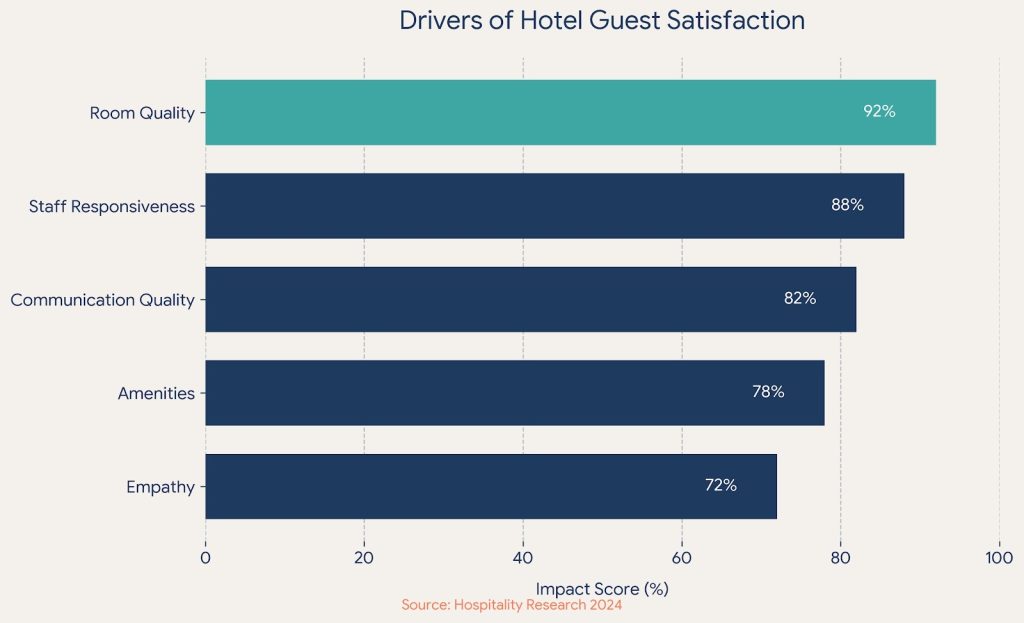
Source: “The Impact of Perceived and Interactive Attributes of Personalized Hotel Services on Customer Satisfaction,” RSIS International, 2025.
“Every gap in internal communication becomes a gap in the guest’s experience. The guest does not see the departments. They only see the result.”
One Broken Link Disrupts the Whole Stay
Think about how many teams touch a single guest during a 48-hour stay. Reservations capture the booking. The front office handles check-in. Housekeeping manages the room. Food and beverage serves meals. Maintenance fixes anything that breaks. The concierge handles requests. Each team carries one piece of the guest’s story. When one team fails to pass that piece forward, the next team starts blind.
A dietary restriction noted at booking disappears by breakfast. An early check-in request sits in one inbox while the room stays unassigned. A late-night noise complaint reaches the log but never reaches the morning manager, so the same noise returns the following night. No single failure breaks the stay. The accumulation does.
Research published in the Cornell Hospitality Quarterly tracked over 500,000 guest satisfaction surveys across 515 hotels over three years. Researchers Christopher Anderson and Saram Han found that detailed, personalized follow-up after service issues improved satisfaction in subsequent stays. Guests who received a specific, timely response after flagging a problem were significantly more likely to leave positive reviews on their next visit.
Source: Anderson, C., & Han, S., “Customer Motivation and Response Bias in Online Reviews,” Cornell Hospitality Quarterly, Volume 61, Issue 2, May 2020.
“A hotel does not lose a guest in one moment. It loses them across several small moments where someone should have known something and did not.”
Departments That Work in Parallel Instead of Together
Most hotel departments run efficiently within their walls. Housekeeping turns rooms on time. The kitchen delivers food at the right temperature. The front desk processes check-ins quickly. But efficiency within a department does not always translate into coordination across teams.
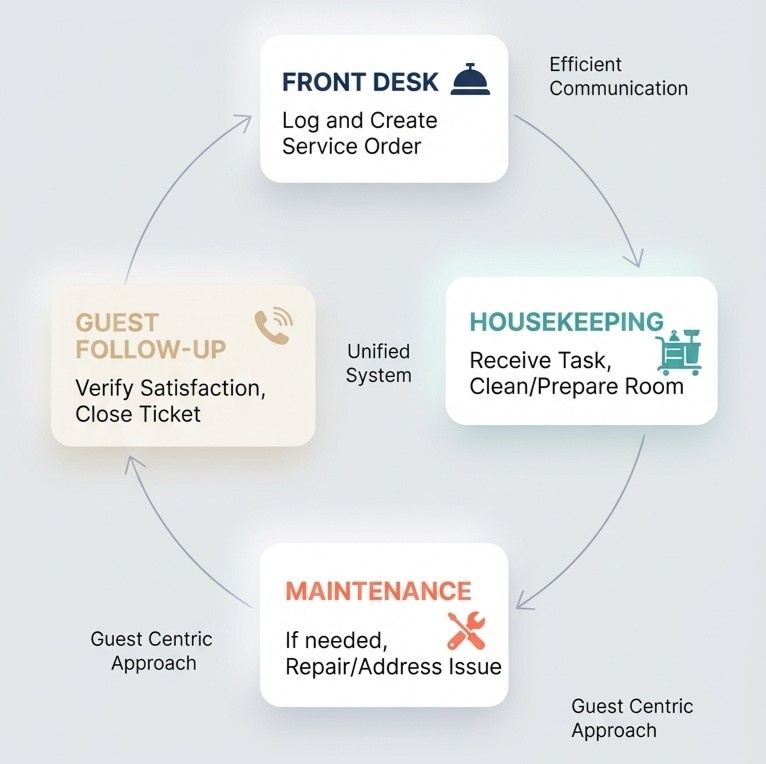
When a guest requests a late checkout, the front desk logs it. Whether that information reaches housekeeping before they start their morning run depends entirely on the quality of the handoff. If the handoff is casual, rushed, or verbal-only, the chances of something falling through rise sharply.
Here is what that looks like in practice. A guest extends her checkout to two in the afternoon. She leaves for a museum at eleven. At noon, a housekeeper enters the room, assumes it is vacant, and begins turning it over. The guest returns to find her suitcase moved and the bed stripped. She had a confirmed late checkout. The hotel failed to honor it, not out of bad intent, but out of a gap between two teams that never fully synced.
A widely cited industry analysis of hospitality service failures identifies missed handoffs between shifts, incomplete guest preference records, and rigid departmental boundaries as the most common sources of communication breakdown. The analysis notes that these failures rarely involve a single careless employee. They involve a system that never made it easy for different teams to share key guest details such as preferences, room requests, service concerns, and previous complaints.
Source: “Crucial Customer Service Challenges in Hospitality,” Industry Analysis, 2025.
“When departments stop talking, guests start feeling it. Guests may not identify a specific problem, but repeated small issues slowly reduce their confidence in the hotel.”
Bad Reviews Rarely Tell the Whole Story
Read enough one-star hotel reviews, and a pattern appears. Guests rarely write, “The plumbing failed.” They write, “I reported the issue twice, and nothing happened.” They write, “Every person I spoke to told me something different.” They write, “It felt like nobody had any idea what was going on.”
These reviews describe the experience of poor communication without using those words. They capture the frustration of repeating oneself, receiving contradictory information, and watching a complaint disappear into a system that never surfaced again.
A study published in the International Journal of Contemporary Hospitality Management (Emerald Publishing) examined hotel reviews across star ratings and found that service quality, not physical facilities, ranked as the primary driver of guest delight and dissatisfaction. Across all hotel categories, inconsistent service had a growing negative impact on international guests, with clear consequences for overall rating scores.
Source: “Comprehending Customer Satisfaction with Hotels,” International Journal of Contemporary Hospitality Management, Emerald Publishing, May 2020.
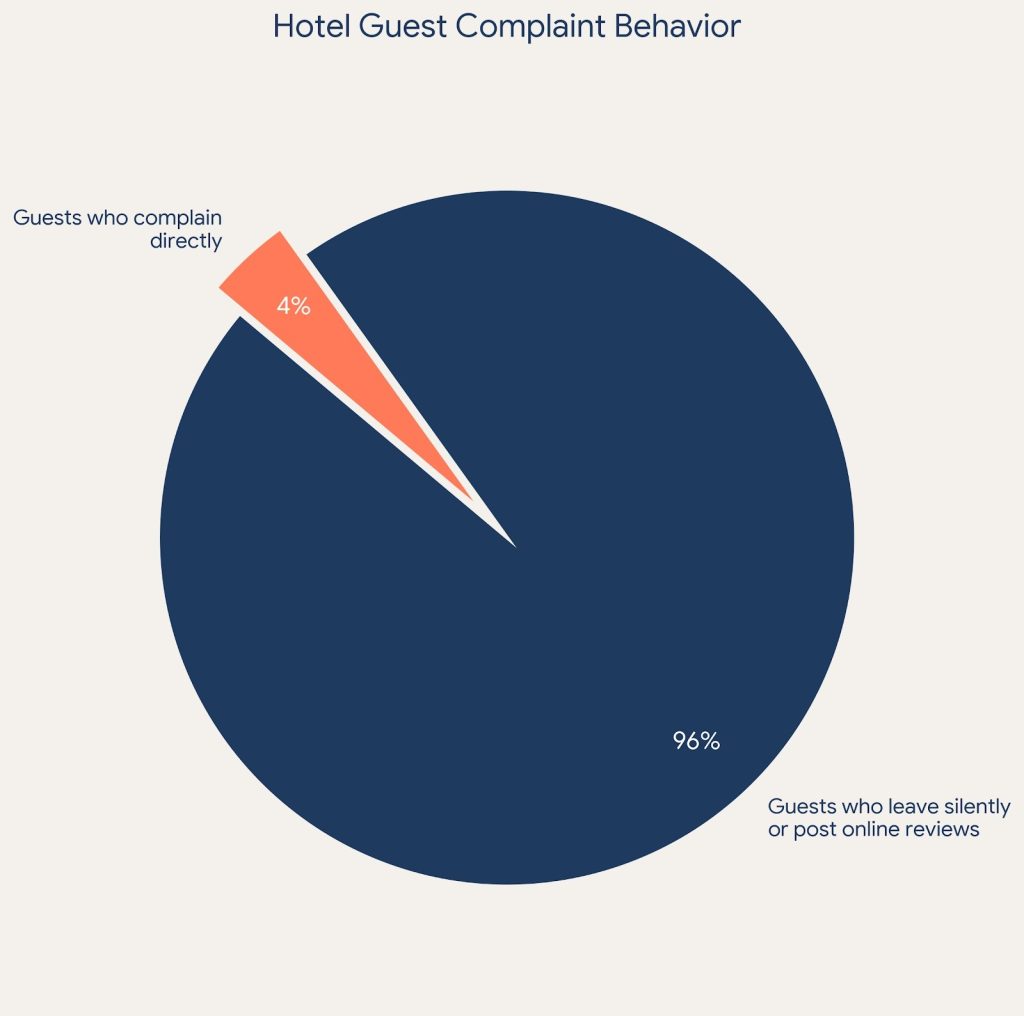
Research from hospitality management institutes adds another layer to this. Only 5 to 10 percent of dissatisfied hotel guests raise their concerns directly with staff. The rest leave quietly, share their frustration on a review platform, and warn the next traveler long before the hotel realizes something went wrong.
Source: Hotel Guest Complaint Handling Research, Hospitality Management Institutes, 2025.
“The reviews that hurt most are not the furious ones. They are the measured ones, where a guest calmly describes a hotel that never seemed to know what its team had promised.”
The Front Desk Carries Everyone Else’s Gaps

Front desk agents occupy the most exposed position in any hotel. They greet guests, handle complaints, field requests, and manage expectations in real time and in full view. They also inherit every communication failure that happened before the guest arrived at their counter.
A VIP guest walks in, and the agent has no record of the upgraded room that was promised at booking. A guest asks about their spa appointment, and the agent stares at a blank screen. A guest returns to report the same maintenance issue for the third time, and the agent has no record of the first two calls. In each case, the agent improvises. They apologize, investigate, and scramble to fix something they had no part in creating.
This is not a training problem. Agents often know exactly what to do. The problem is that no one shared the guest’s preferences, requests, and previous concerns with them before the guest arrived.
A mixed-methods study published in the Journal of Commerce Management and Tourism Studies (December 2025) found that proactive communication, real-time access to guest history, and clear empowerment of front-line staff significantly improved complaint handling outcomes. Properties that integrated CRM tools with live feedback systems gave agents the context they needed to resolve issues faster and with greater accuracy.
Source: “Effective Guest Complaint Management for Hotel Front Office Staff,” Journal of Commerce Management and Tourism Studies, Volume 4, Issue 3, December 2025.
“Front desk agents do not fail guests. Under-informed systems do. The agent standing at that counter can only work with what the rest of the hotel chose to pass along.”
The Quiet Guest Is the Dangerous One
Hotels spend considerable effort managing vocal complaints. A guest who raises their voice at the front desk gets immediate attention, a manager, and perhaps a room upgrade. The hotel logs the incident, resolves it, and considers the matter closed.
But silence from a guest does not mean everything went well. She simply decided the effort of complaining was not worth it. She finishes her stay, collects her bags, and writes a three-paragraph review that evening that will influence the decisions of thousands of future guests.
A Coyle Hospitality Group study analyzed over 11,000 data points from 525 upscale hotel visits and found that hotels responded quickly to reported problems but consistently failed to follow up after resolving them. Staff handled the issue but never followed up to confirm with the guest that the problem was truly resolved. Guests left uncertain, and that uncertainty colored their overall impression of the stay.
Source: Coyle, J., “The New Service Recovery Paradox: Step It Up With Follow-Up,” Coyle Hospitality Group, 2014.
Research published in the Cornell Hospitality Quarterly studied 288 guests across seven high-end hotels and confirmed that when hotels handle service failures well and communicate clearly through the recovery process, guest loyalty increases measurably. The connection between good follow-through and repeat business holds across hotel categories and markets.
Source: Zoghbi-Manrique-de-Lara, P., et al., “Hotel Guests’ Responses to Service Recovery,” Cornell Hospitality Quarterly, 2014.
“A quiet checkout does not mean a satisfied guest. It often means a guest who stopped expecting anything better and started composing their review in their head on the way to the car park.”
What Hotels That Get This Right Actually Do
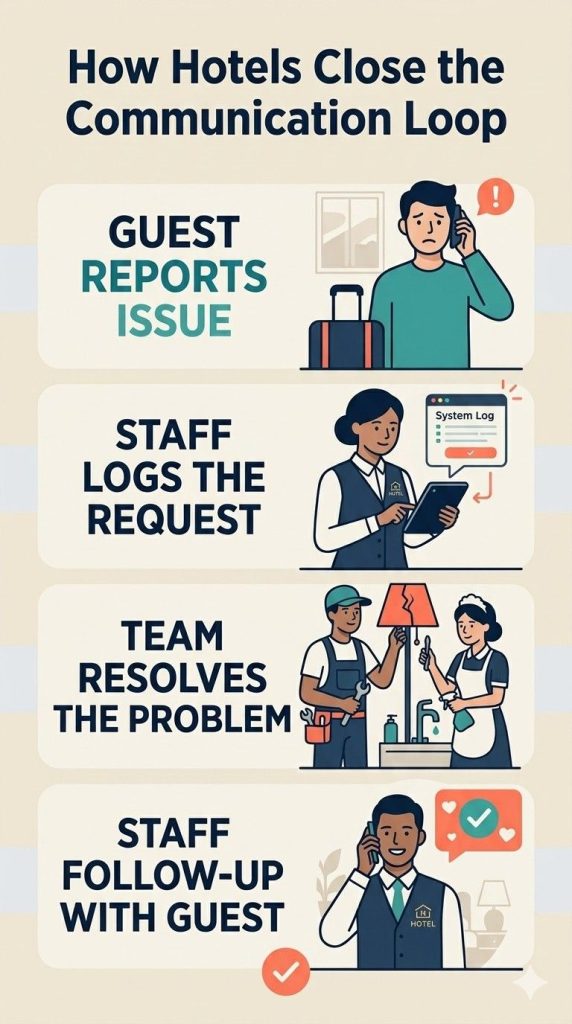
Hotels with strong guest communication share one quality that sets them apart: they treat information as a resource that needs active management, not passive assumption.
Formalize Shift Handoffs
They formalize shift handoffs. Instead of a five-minute verbal rundown between departing and arriving staff, they maintain structured written logs that capture every open issue, pending request, and guest note from the previous shift. The incoming team reads it before the first guest interaction of the day.
Make Guest Preferences Visible Across Departments
They make guest preferences visible to every department that touches that guest. A dietary note does not live only in the reservations system. It travels to the restaurant, to room service, to the minibar setup. The preference captured at booking becomes the preference honored at every touchpoint.
Close the Loop on Every Guest Issue
They close every loop. When a guest reports a problem, someone follows up, not to ask whether the guest is satisfied, but to confirm that the resolution actually happened and was held. That follow-up call or message is the moment a frustrated guest decides whether to trust the hotel again.
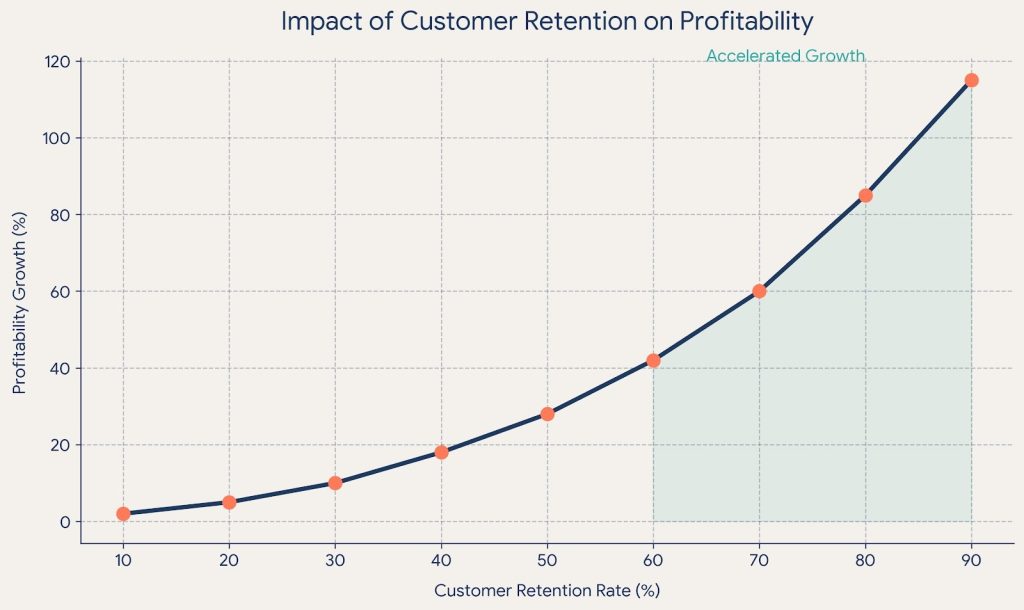
A Cornell Hospitality Research report found that a five percent increase in customer retention in hospitality can lift profits between 25 and 95 percent. The small operational actions that drive guest retention are rarely dramatic. It is built on the quiet discipline of consistent, accurate internal communication repeated across every shift, every team, and every moment staff speak with, assist, or respond to a guest.
Source: Cornell University, “The Value of Customer Retention in the Hospitality Industry,” Cornell Hospitality Research Quarterly, Volume 12, Issue 2, 2020.
Personalize Responses to Guest Concerns
A 2025 study published in ScienceDirect tested how guests responded to different types of replies to their concerns and reviews. Full, personalized responses produced the highest satisfaction and the strongest perception of service quality. Generic or partial responses consistently fell short, regardless of how polite or professional they sounded.
Source: “Satisfaction with Response: The Impact on Potential Customers’ Perceived Service Quality and Intent to Stay,” ScienceDirect, April 2025.
“Hotels that get communication right do not necessarily have more talented people. They have better systems, sharper handoffs, and a shared belief that passing information accurately is as important as any guest-facing skill.”
Final Thoughts
Feeling overlooked drives guests away more often than dirty rooms or slow lifts. That feeling almost always traces back to a moment when information stopped moving inside the building while the guest kept moving through it.
The staff in most hotels genuinely want to do a good job. They care about the guest standing in front of them. The problem is not will. The problem is infrastructure. When teams share information precisely, when handoffs happen with intent, and when someone takes ownership of the guest’s experience across every shift, the whole stay changes.
Guests who feel that kind of coherence do not just leave satisfied reviews. They come back. They recommend the property. They give the hotel the benefit of the doubt the next time something goes slightly wrong, because the pattern of care they experienced already told them this place actually pays attention.
That is what good internal communication produces. Not just smoother operations. A reason for the guest to return.