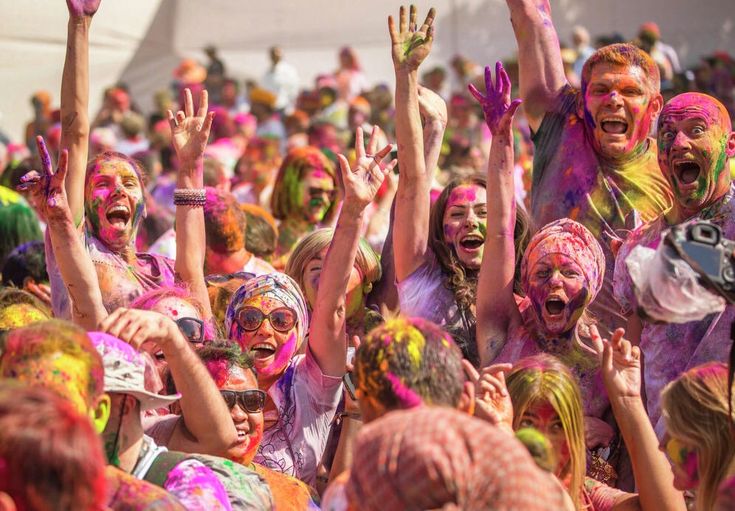
Every spring, hundreds of millions of people step outside and throw bright-colored powder at each other, dance in the streets, eat sweets, and hug strangers. The air turns pink, yellow, blue, and green. Laughter drowns out everything else. This is Holi, and it is one of the most joyful days on the planet.
“Color is the place where our brain and the universe meet.” – Paul Klee
So, what exactly is Holi?
Hindus celebrate Holi every spring as a joyful festival that marks the arrival of the new season. Hinduism is one of the world’s oldest and largest religions, with over a billion followers, practiced mostly in India and Nepal.
Hindus celebrate Holi widely, and people from many backgrounds actively take part in the festival. The celebration brings communities together and encourages people to share in the joy, regardless of their religion or culture.
At its heart, Holi is a celebration of spring arriving, of winter ending, of good triumphing over evil, and of love and joy shared between people. It is joyful, loud, physical, and deeply communal.
The festival lasts two days. People call the first evening Holika Dahan and light large bonfires to mark it. They celebrate the second day as Rangwali Holi or Dhuleti, which most people recognize as the main day of colors. It is the day of colors.
The Story Behind Holi
Every major Indian festival has a story attached to it. Holi has a powerful one.
Long ago, a demon king named Hiranyakashipu ruled his kingdom. He had received a special blessing from the gods that made him almost impossible to kill. He grew arrogant.
He demanded that everyone in his kingdom worship him and only him. But his own young son, Prahlad, refused. Prahlad was a devoted follower of the Hindu god Vishnu, and no threats from his father could change that.
Hiranyakashipu tried everything to kill his son. Nothing worked. So he turned to his sister, Holika. Holika had a magical cloak that made her fireproof. She sat in a massive bonfire with Prahlad in her lap, certain he would burn.
But something unexpected happened. The wind swept Holika’s cloak off her and onto Prahlad instead. Holika burned. Prahlad survived. Good had won.
The bonfire of Holika Dahan is not just a ritual. Each year, people light it to remind themselves that love and faith defeat cruelty and arrogance.
The next morning, people celebrated by throwing colors at each other, dancing, and spreading joy in the streets. That tradition has continued for thousands of years.
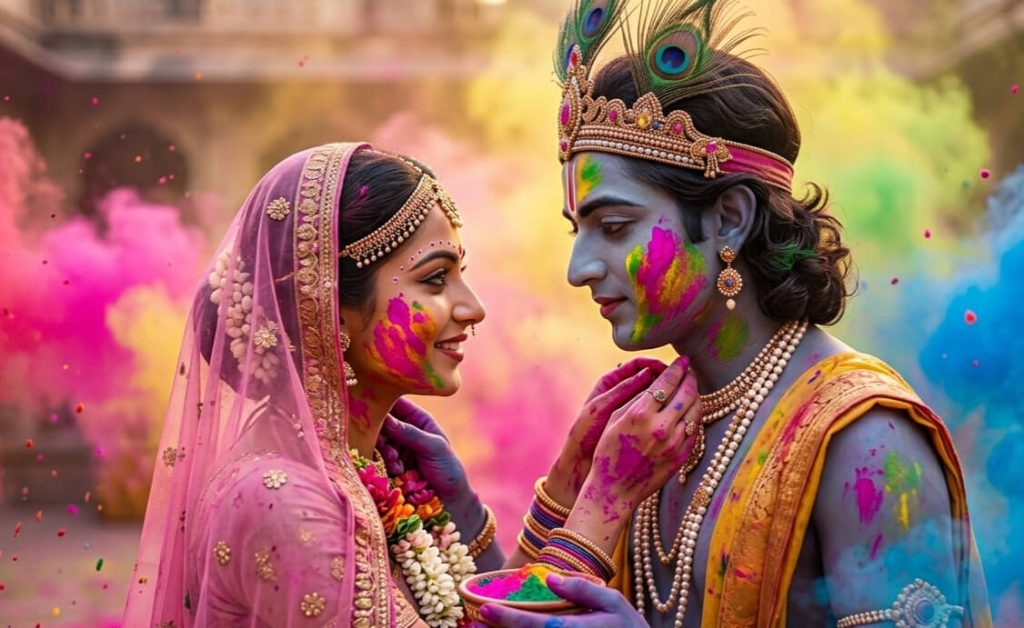
A second story also shapes Holi, and this one carries a more playful tone. It involves the Hindu god Krishna, one of the most beloved figures in all of Hindu mythology. Krishna grew up in a small village in northern India. As a young man, he deeply loved a woman named Radha.
Krishna had a darker complexion than Radha, and as a young boy, he wondered if she would accept him. His mother, a little tired of his complaints, told him to go color Radha’s face whatever color he wished.
He did, and Radha and Krishna became the eternal symbol of divine love in Hinduism. To this day, people consider that town the spiritual home of Holi, and they celebrate the festival there for weeks.
When Does Holi Happen?
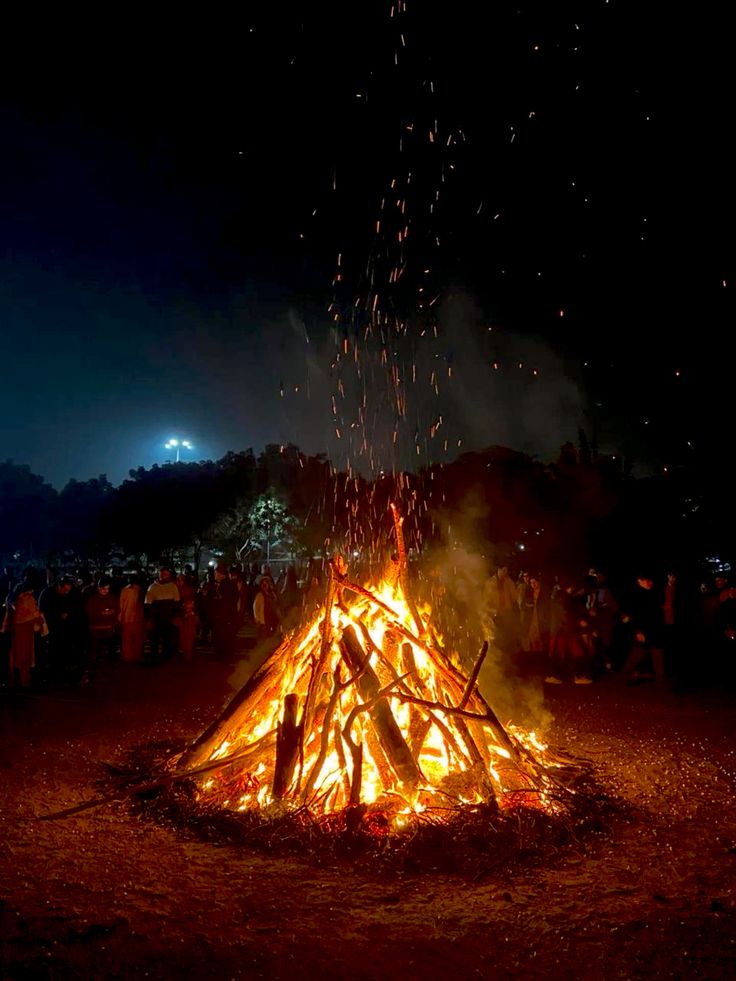
Holi does not fall on the same date every year. It follows the Hindu lunar calendar, which means the date shifts each year. Holi always falls on the full moon day of the Hindu month called Phalgun, which lands somewhere in late February or March.
The night before the main celebration, families and neighborhoods gather around bonfires to mark Holika Dahan.
People walk around the fire, offer prayers, and sometimes throw coconuts, grains, or popcorn into the flames as an offering. The fire symbolizes the burning away of evil and negativity.
Then, the very next morning, the real celebration begins.
The Day of Colors
On the morning of Holi, people wake up early. They choose old clothes because the colors will stain whatever they wear and almost certainly ruin it. They step outside with bags of colored powder called gulal and water guns and water balloons. Then the chaos begins.
Neighbors throw color at each other. Friends chase each other through the streets. Strangers walk up to you and smear a palmful of bright pink or green powder across your cheek. You look up, and a water balloon full of blue dye explodes on your shirt. Children climb onto rooftops and dump buckets of colored water on people walking below. Everyone laughs. Nobody minds.
This is the unique magic of Holi. For one day, the normal rules of social interaction dissolve. People set aside age, wealth, social status, and even family tensions during the celebration. Holi is a day of radical equality. A person who might never normally speak to their neighbor will chase them down a street with a handful of yellow powder.
By noon, the main celebration winds down. People head home, shower for a long time, and then come back out again. This time, they wear clean white or light-colored clothes. Families visit each other, exchange sweets, and share a meal. The second half of Holi feels quieter and warmer, and families fill it with affection rather than mayhem.
“In the depth of winter, I finally learned that within me there lay an invincible summer.” – Albert Camus
The Colors Themselves
People call the colored powder used during Holi gulal. Originally, these colors came entirely from nature. People dried flowers, leaves, roots, and bark and ground them into powder. Each color carried a meaning.
Red stands for love, fertility, and new beginnings. It is the most traditional and important color of Holi.
Yellow comes from turmeric and stands for happiness, good health, and prosperity. Turmeric has been sacred in Indian culture for thousands of years.
Green represents new life, harvest, and nature coming back to bloom. It is the color of spring itself.
Blue represents Lord Krishna, and Hindu art and scripture depict his skin in a deep blue shade.
Pink is the color of joy and playfulness. It carries no heavy symbolism. It just feels happy.
Orange reflects saffron, a sacred color in Hinduism that represents courage and sacrifice.
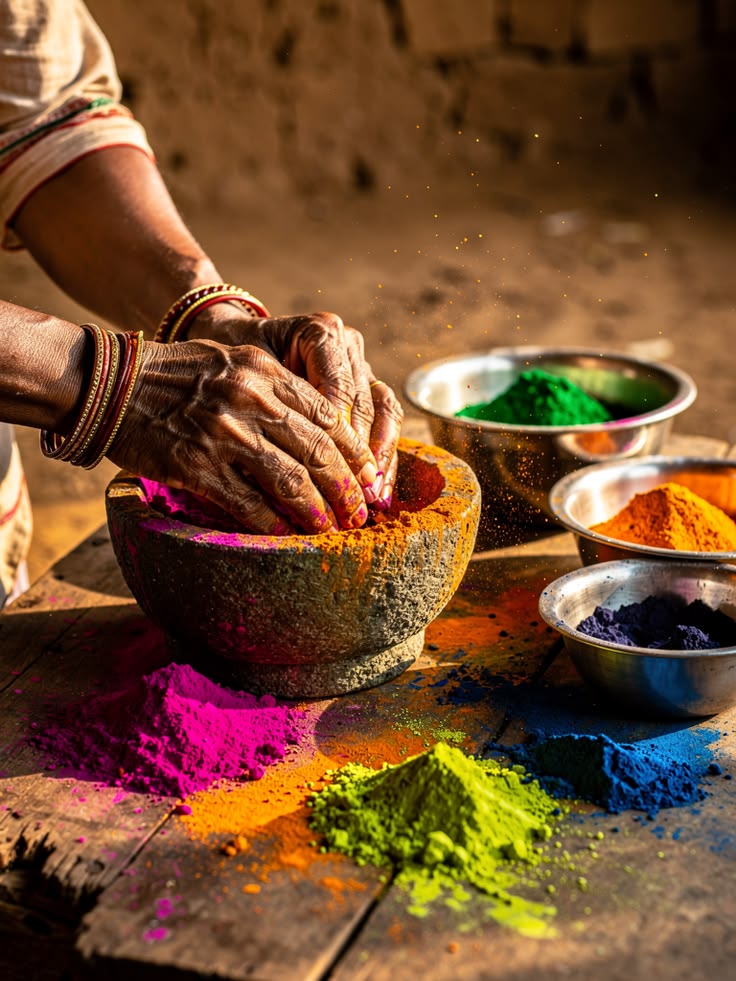
Today, manufacturers produce most Holi colors synthetically, which makes them cheaper and more vivid. However, there has been a strong movement in recent years back toward natural and organic colors, both for skin safety reasons and to revive a traditional practice. Organic gulal made from flower petals, beetroot, sandalwood, and other plant sources is widely available now.
One important caution: not all Holi colors are safe. Some synthetic colors contain heavy metals, industrial dyes, and harsh chemicals that can irritate skin and eyes. If you participate in Holi, look specifically for colors labelled “organic,” “herbal,” or “natural.” A little research before buying makes a big difference.
The Food of Holi
No Indian festival is complete without food, and Holi has some truly distinctive dishes attached to it. After the morning’s mayhem ends, families gather to eat.
Thandai is the most iconic Holi drink. People prepare it as a cold, spiced milk drink with almonds, cardamom, saffron, black pepper, and rose petals.
It is sweet, fragrant, and deeply satisfying. Some versions include bhang, a preparation made from cannabis leaves, which is traditional and legal in certain regions during Holi.
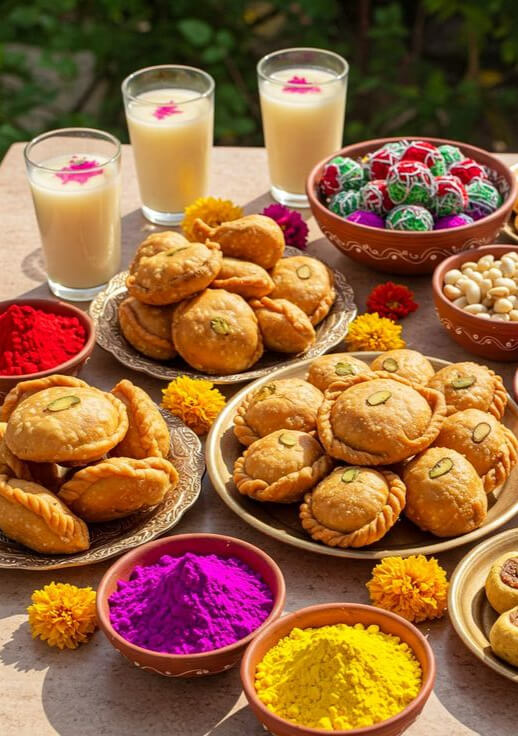
Gujiya is the most iconic Holi sweet. People shape it like a half-moon, deep-fry it, and fill it with sweetened dried fruits, nuts, and coconut.
Cooks make malpua by mixing flour, milk, and fennel seeds, frying the batter until golden, soaking it in syrup, and often serving it with thickened cream called rabri.
Cooks prepare Puran Poli by stuffing flatbread with a sweet filling of lentils and jaggery, an unrefined cane sugar. It is especially popular in Maharashtra and Gujarat.
Cooks soak soft lentil dumplings in cool yogurt and top them with tamarind chutney and spice powders to make Dahi Bhalla. This savory dish balances out all the sweets perfectly.
“Food brings us together and connects us all.”
How Holi Looks Across India
India is a massive country with enormous regional diversity. Holi takes on a distinct character in each region, shaped by local customs, traditions, and community spirit.
In the twin towns of Krishna’s birthplace region in Uttar Pradesh, closely associated with Lord Krishna, celebrations begin a week before the main day and continue well beyond it.
The most famous version here is Lathmar Holi, where women chase men with wooden sticks while men try to shield themselves. It sounds rough, but it is entirely playful and deeply traditional, recreating a legend about Krishna and the women of his village.
In Rajasthan, people celebrate Holi with classical music and vibrant street processions. The royal families of cities like Udaipur and Jaipur used to host formal Holi celebrations in grand palace courtyards, some of which still happen today.
In West Bengal, people call Holi Dol Jatra or Dol Purnima and give it a more spiritual tone. Devotees place statues of Radha and Krishna on decorated swings and carry them through the streets while people throw color and flower petals.
In Punjab, a day after Holi, Sikhs celebrate a related festival called Hola Mohalla, started in the 18th century by Guru Gobind Singh, the tenth Sikh Guru. It involves martial arts demonstrations, mock battles, and a spirit of bravery and community rather than color play.
In Mumbai, India’s largest city, housing societies set up giant stages with music, and young people dance for hours covered in color. It looks and feels like a massive outdoor music festival that also happens to involve gulal flying everywhere.
What Holi Really Means
You can understand the mechanics of Holi in five minutes. But the real meaning is harder to explain and much easier to feel.
India is a complicated country. It has significant economic inequality. It has a caste system that, despite it being officially illegal to discriminate based on, still shapes daily life for many people. It has religious tensions and political divisions.
On Holi morning, a young man from a wealthy family gets a face full of purple powder from his neighbour’s child, and both of them burst out laughing, sharing an honest, unguarded moment. The hierarchy steps back, even if only for a few hours.
There is a Hindi phrase that belongs entirely to this day:
“Bura na maano, Holi hai.”
It translates to:
“Don’t take offense; it’s Holi.”
Someone throws color at you? Bura na maano, Holi hai. Someone you have a disagreement with comes to your door with sweets? Bura na maano, Holi hai. The phrase is permission to forgive, to be silly, to be open, and to start fresh.
Spring itself matters deeply here too. India’s agricultural heartland depends on the harvest cycle. Holi lands at the end of winter, when crops have been harvested and a new growing season is about to begin. People feel full, relieved, and grateful. The festival channels all of that energy outward into pure celebration.
A Few Things Worth Knowing
Not everyone in India celebrates Holi. India is home to Muslims, Christians, Sikhs, Jains, Buddhists, and many other communities. Hindus celebrate Holi, and while many non-Hindus join the fun, especially in mixed neighborhoods, people do not observe it with equal enthusiasm everywhere. In South India, for example, communities celebrate Holi far more quietly than in the North. In the Northeast, different communities have their own spring celebrations.
Bhang and Holi. In several northern states, consuming bhang during Holi is a centuries-old tradition. People make bhang from cannabis leaves and mix it into thandai or shape it into small balls called bhang pakoras.
Certain Hindu traditions consider it sacred, and specific Indian states allow people to consume it during the festival. Most family-oriented celebrations do not involve it, but it exists, it is traditional, and it is worth knowing about.
The environment. Large-scale Holi celebrations create real environmental challenges. Synthetic colors washed into rivers and lakes can harm aquatic life. Many environmentalists and cultural preservationists in India strongly advocate for organic colors and water-conscious celebrations. It is an ongoing and important conversation within the country.
If You Want to Celebrate Holi
You do not have to be Hindu or Indian to participate in Holi. The festival has always welcomed outsiders. Here is what helps if you plan to join a celebration.
Wear old clothes you do not mind losing. White clothes are traditional and show color beautifully, but anything you wear will still get stained. Apply coconut oil to your skin and hair before the event because it creates a barrier that makes the color much easier to wash off later.
Wear sunglasses or goggles to protect your eyes from powder. Bring a change of clothes in a sealed bag. Leave expensive jewelry and electronics behind.
Most importantly, do not throw color at someone who has not consented to participate. Ask first. People share the entire spirit of Holi willingly, and that matters more than anything else.
Holi is the one day a year when the whole neighborhood becomes one family and nobody asks permission to join in. Whether you encounter it in a street in Mumbai, a temple courtyard, or at a community event near you, it will leave color on your clothes, a little powder in your hair, and very likely a smile you did not expect.
Holi fulfils its purpose exactly as intended.
“Holi is not about color on your skin, but about color in your connection with others.”
Wishing everyone a joyful and colorful Holi. Warm greetings from all of us at Geedesk.